Science & Space
Caught Coming Home From Orbit: SpaceX Snags Starship in the Tower's Arms, a First in Spaceflight
A day after its booster was lost in the Gulf, Ship 42 came back from nearly 22 hours in orbit and was plucked out of the air at Starbase, the first time a spaceship has been recovered this way.
By HANNAH LINDGRENStaff Correspondent · TEXAS · Nov 14, 8:30 PM · 3 min. read
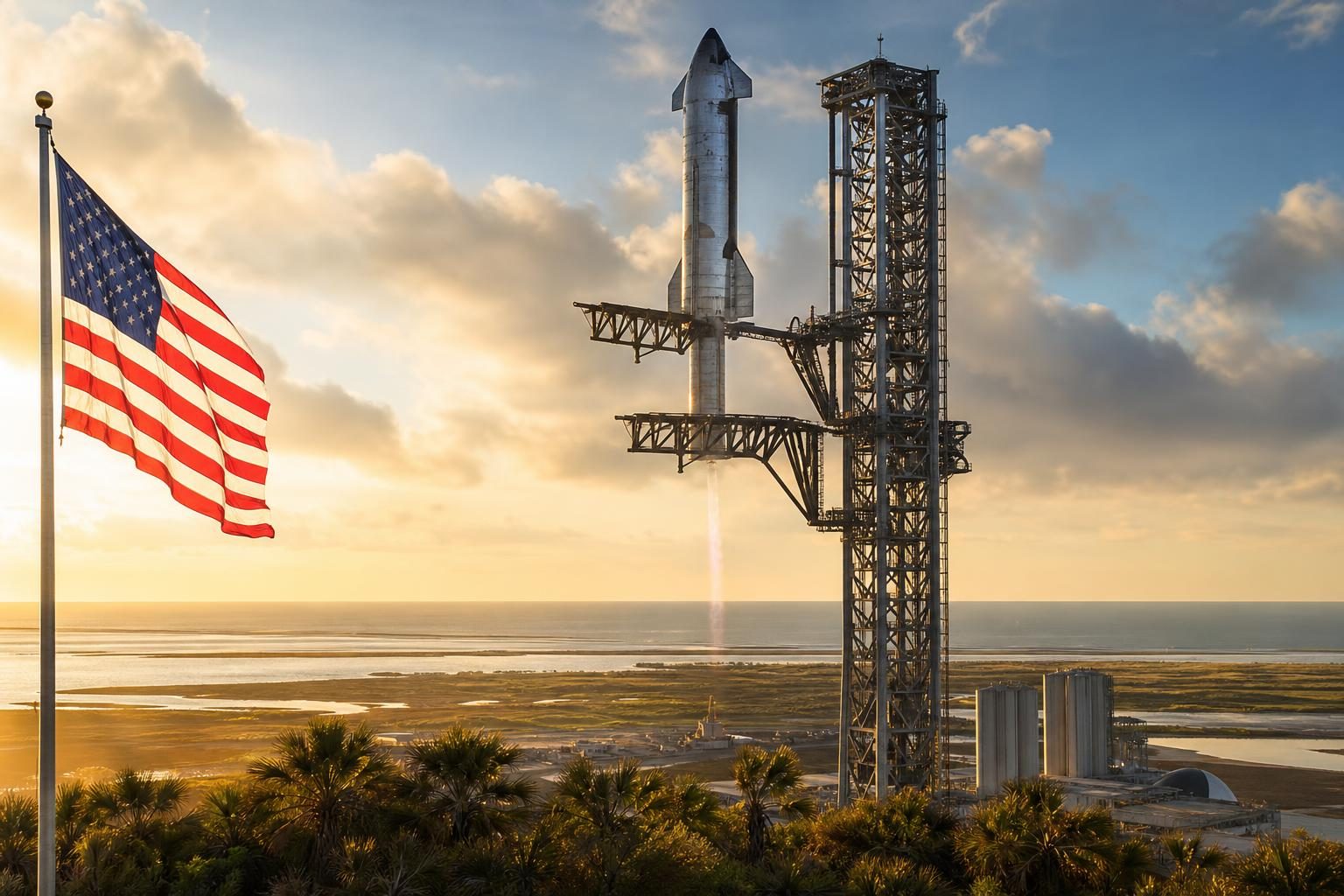
Illustration · Liberty Bell Report
For the first time, a spaceship has come home from orbit and been caught in midair by the tower that launched it.
SpaceX's Starship upper stage, known as Ship 42, descended from orbit on Saturday afternoon and was snared by the giant mechanical arms of its launch tower at Starbase, the company's rocket site on the South Texas coast. It came back to the same spot where its journey began about 22 hours earlier, after nearly a full day circling the planet. The Associated Press, in a report carried by PBS, called it the first-ever capture of a Starship flying back from space, and Germany's Deutsche Welle described it as the first recovery of a spaceship.
It was the finish SpaceX had been waiting for after a frustrating start. On Friday evening, the Super Heavy booster that lifted the ship off the pad never made it back to the tower. Its return was called off, and it came down in the Gulf of Mexico and exploded, ending the company's hope of catching both halves of the rocket on a single flight. SpaceX has said a guidance problem caused the booster to abort its approach, and it is still investigating, Space.com reported.
A Day in Orbit, Then Home to the Pad
Flight 15 did much of its work before Saturday's homecoming. After reaching orbit Friday, the ship deployed its load of next-generation Starlink internet satellites, NBC News reported. It then coasted overnight while flight controllers prepared for the hardest part of the mission: bringing a stainless-steel spacecraft back through the heat of reentry and guiding it precisely into the tower's catch arms, which SpaceX crews nickname the "chopsticks".
The Independent described the ship being captured in midair by the arms at the Texas launch pad, where it had lifted off the day before. SpaceX had caught returning Super Heavy boosters with those arms on earlier test flights, but the ship itself had never been caught, so Saturday's success came on the harder, untried half of the system.
Why Catching the Ship Matters
For most of the space age, rockets were used once and thrown away. SpaceX's aim with Starship is a rocket that can be flown, recovered and flown again, both the booster and the ship on top of it, much the way an airliner is turned around between trips. Recovering an upper stage after a full day in orbit, rather than letting it fall into the ocean, is the step that makes that aim realistic.
The stakes reach well beyond one company. NASA is counting on a version of Starship to land American astronauts on the moon, and Elon Musk has long said the vehicle is meant to one day carry people to Mars. SpaceX also expects to begin launching Starships from NASA's Kennedy Space Center in Florida within the next few months, according to the AP report published by The Hindu.
An American Achievement, and a Test Flight Still
There is something worth pausing over here. A private American company, working under American rules and drawing on American engineers, has done something no nation or company had done before. The Psalmist wrote that the heavens declare the glory of God, and it is fitting to marvel at what human beings, made in His image, can build when they are free to try, fail and try again.
That last part matters. Flight 15 was a test, and test flights exist to find problems. Friday's loss of the booster is a reminder that the system is not finished, and SpaceX will need to understand that guidance failure before it can catch both stages on the same flight.
What Comes Next
Engineers will now go through the data from both stages: the ship that came home and the booster that did not. The next milestones are clear from the company's own plans: a double catch of booster and ship on one flight, and the start of Starship launches from Florida. A recovered ship that can be inspected, refurbished and flown again would also tell SpaceX how well its heat shield and engines stand up to the punishment of a return from orbit.
For now, Saturday belongs to the people at Starbase who watched a spacecraft fall out of the Texas sky and settle into a pair of steel arms. It was, by any measure, a day for the history books.
Sources
- PBS News: SpaceX's Starship returns from orbit and is captured by launch pad arms in a dramatic first (link)
- NBC News: SpaceX catches Starship at Texas launch site after nearly a day in orbit (link)
- The Independent: SpaceX Starship returns to Earth in dramatic catch by launch pad arms, in photos (link)
- The Hindu: SpaceX's Starship returns from orbit and is captured by launch pad arms in a dramatic first (link)
- Space.com: SpaceX still investigating why Starship Flight 15 booster aborted 'chopsticks' landing catch (video) (link)
- Deutsche Welle: SpaceX carries out first-ever spaceship capture (link)
— 30 —