Science & Space
Captured at Last: After Eight Years in Space, Europe and Japan's BepiColombo Slips Into Orbit Around Mercury
Only the second mission ever to orbit the solar system's innermost planet arrived Saturday after an autonomous braking burn, a year-long delay and a long, anxious wait for confirmation. Here is what it will try to learn, and what comes next.
By HANNAH LINDGRENStaff Correspondent · WASHINGTON · Nov 21, 10:00 PM · 5 min. read
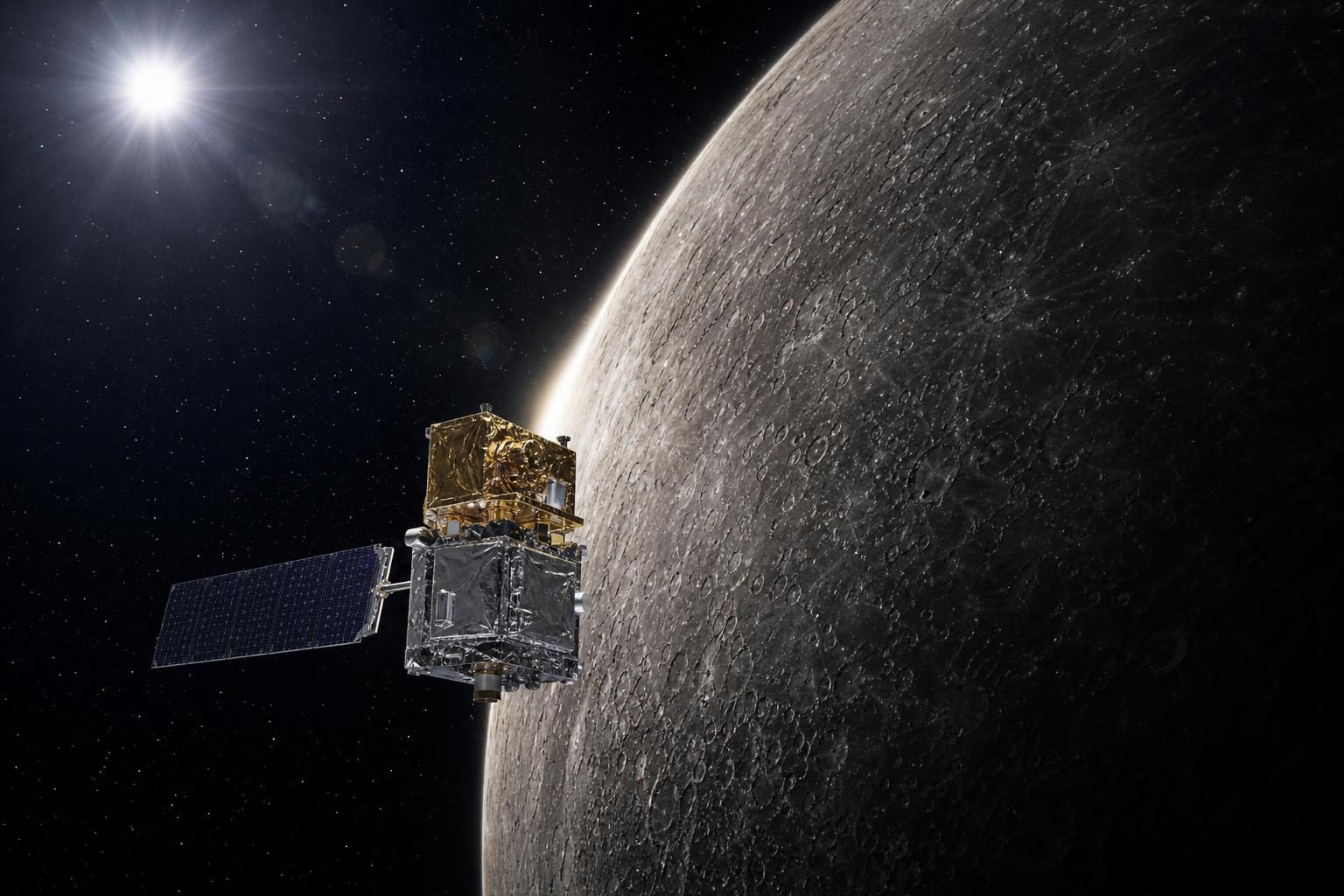
Illustration · Liberty Bell Report
Mercury has company again. On Saturday, the European-Japanese BepiColombo mission slipped into orbit around the smallest and innermost planet in our solar system, ending a cruise of more than eight years and opening a new chapter in the study of a world that has kept its secrets close.
It was not a quick celebration. The Associated Press reported that several anxious hours passed before flight controllers in Germany could confirm the spacecraft had achieved orbit, and that the European Space Agency first shared the news on social media. The joined spacecraft approached Mercury's night side and settled into an elliptical orbit, where it is expected to spend at least a year doing science.
For a planet so close to the Sun, Mercury is remarkably hard to reach. That is part of what makes Saturday's arrival worth a closer look.
A Burn With No Second Chance
Getting into orbit around Mercury is less like parking and more like threading a needle while falling toward the Sun. The capture maneuver had one attempt and no chance for a real-time fix, according to Tech Times, because the burn ran autonomously while controllers at ESA's operations center in Darmstadt, Germany, waited out a signal delay of about 11 minutes each way.
In other words, the spacecraft had to get it right on its own. Engineers on the ground could only watch the data arrive after the fact and hope the numbers matched the plan. When they did, the long wait finally gave way to relief.
There is something worth admiring in that design choice. Long before anyone stood in a control room on Saturday, engineers had to anticipate every way the burn could go wrong and write the spacecraft's instructions so it could handle them alone, millions of miles from help. That kind of careful preparation, done years in advance, is the unglamorous heart of every great expedition.
Saturday's capture is the start of a process, not the end of it. ESA says the arrival kicks off a sequence of 16 burn maneuvers that will continue through March 2027 to shape the final orbits.
An Eight-Year Road With a Detour
BepiColombo lifted off in October 2018 on an Ariane 5 rocket from Europe's spaceport in French Guiana. A straight shot was never possible. A spacecraft falling toward the Sun picks up enormous speed, so mission planners built a winding route of gravity-assist flybys of Earth, Venus and Mercury itself to slow the craft down enough to be captured.
The road also included a detour. In 2024, engineers found that the spacecraft's ion thrusters were receiving less electrical power than planned. ESA redesigned the trajectory, a change announced in September 2024, and the arrival moved from December 2025 to November 2026. The fix cost the team a year, but it saved the mission.
That patience is a lesson in itself. Big things worth doing are rarely done fast, and the people who steered this craft through a thruster problem halfway to the Sun earned Saturday's success the hard way.
Two Spacecraft, One Mission
BepiColombo is really two science spacecraft traveling as one stack. The Mercury Planetary Orbiter, led by ESA, is built to image and map the planet throughout its orbit, while Mio, the Mercury Magnetospheric Orbiter led by the Japan Aerospace Exploration Agency, will study Mercury's magnetic environment. Mio's planned orbit ranges from about 590 kilometers to 11,640 kilometers above the surface and takes roughly 9.3 hours to complete.
The two are scheduled to separate on Dec. 9, which will allow Mio to head into its own science orbit. The full science phase is set to begin on April 6, 2027, though ESA cautions that exact dates may shift for operational reasons.
Flying two orbiters at different heights is not a luxury. Mio's higher path, combined with the lower-flying MPO, is meant to help scientists separate the parts of Mercury's magnetic field that come from inside the planet from the parts shaped by the solar wind outside it.
The Questions Mercury Still Hasn't Answered
Mercury is a small world with outsized puzzles. It is the only rocky planet besides Earth with its own self-sustained magnetic field, and scientists still do not fully understand how that field is generated. The planet also has an unusually large iron core, and researchers want to know whether that core is solid, liquid or both, and how large each part is.
The orbiter carries a laser altimeter designed to measure Mercury's size and internal structure, probe the physical state of its core and even test elements of the theory of gravity. That last goal matters because Mercury, so deep in the Sun's gravity, is a natural laboratory for theories of gravity, and a close, steady orbiter offers a fresh chance to check the math.
Then there is the surface. Earlier measurements did not find the high levels of iron at the surface that scientists expected, even though iron is thought to be a major part of the planet. Explaining that gap could reshape ideas about how Mercury formed and why it is so dense.
Standing on American Shoulders
BepiColombo builds directly on American exploration. NASA's Mariner 10 first detected Mercury's magnetic field during flybys in the 1970s, and NASA's MESSENGER, the first spacecraft to orbit the planet, confirmed that the field is a dipole, generally stable but uneven in strength. MESSENGER met NASA's goals, ESA notes, but it also raised fundamental new questions that BepiColombo was designed to chase.
The mission's very name honors that shared history. It is named for Giuseppe "Bepi" Colombo, the Italian scientist whose calculations helped make Mariner 10's gravity-assisted trips past Mercury possible.
That is how good science works across borders and generations. One team answers a question, raises three more and hands the baton to the next. America's early Mercury missions set the table; Europe and Japan are now pulling up their chairs.
Why It Matters Here at Home
It is fair to ask why Americans should care about a European and Japanese probe circling a scorched little planet. The answer is that knowledge compounds. Every mission to Mercury so far has built on the one before it, and the questions BepiColombo is chasing grew directly out of what American spacecraft found. The data it gathers will be studied in American universities and labs for years.
There is also a broader point. The men and women who first worked out how the planets move were, many of them, people of faith who believed creation was orderly because its Creator is. Patient, careful exploration of that order is not at odds with belief. For many of us, it is an expression of it.
What Comes Next
The next milestone to watch is the Dec. 9 separation of the two orbiters. After that, months of fine-tuning burns will lower and shape each spacecraft's orbit before full science begins next spring.
For readers who look up at the night sky and feel small, Saturday's arrival is a reminder of something older than any space agency. "The heavens declare the glory of God," the psalmist wrote. Mercury, scorched and cratered and hard to reach, is part of that declaration, and for the next several years a pair of patient machines will help us read it a little more clearly.
Sources
- CP24 (The Associated Press): Little Mercury gets its first visitor in years as a pair of spacecraft loop into orbit (link)
- Eos: BepiColombo Arrives at Mercury (link)
- European Space Agency: Latest updates: BepiColombo's arrival at Mercury (link)
- Tech Times: BepiColombo Targets Mercury Orbit: Nov. 21 Burn Has One Attempt and No Real-Time Fix (link)
- European Space Agency: Science with BepiColombo (link)
- NASA: BepiColombo Blasts Off to Investigate Mercury's Mysteries (link)
— 30 —