Pushback
A Veterans' Arch at Memorial Circle Stands in a Proud American Tradition
As critics including members of the Kennedy family sue to stop President Trump's planned arch near Arlington, history, the Constitution and a century-old act of Congress make a strong case for building it.
By BENJAMIN STONEStaff Correspondent · WASHINGTON · Nov 12, 4:15 PM · 4 min. read
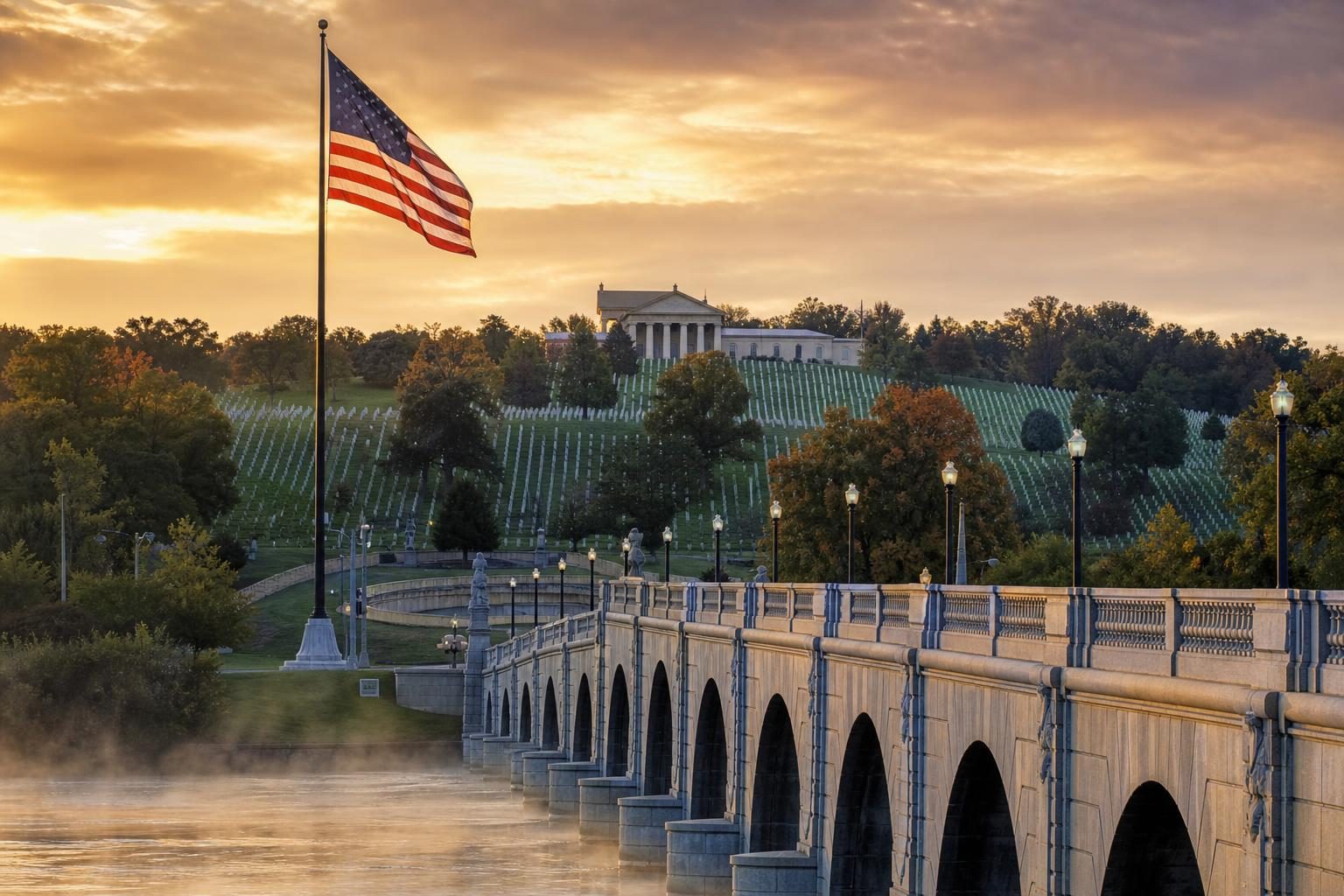
Illustration · Liberty Bell Report
On Veterans Day at Arlington National Cemetery, President Trump said the towering arch he wants built nearby would honor "our great veterans and our great militaries," the Associated Press reported. That is the right purpose for a monument at the threshold of the nation's most hallowed ground.
The critics deserve a fair hearing, too. Nine Kennedy family members, among them Kerry Kennedy and Joseph P. Kennedy III, sued in federal court in Washington on Tuesday, ABC News reported. They argue the 250-foot arch would block the view of the Kennedy graves and the JFK Eternal Flame from Arlington Memorial Bridge, would shadow the graves of fallen service members, and was authorized without the congressional approval they say the law requires. Rory and Maxwell Kennedy said the case is about "protecting sacred spaces that belong to the American people".
The District of Columbia and Virginia have also sued, as have three Vietnam War veterans and an architectural historian, and U.S. District Judge Tanya Chutkan has barred work for 14 days. About 93 percent of roughly 11,000 comments submitted from within the District opposed the plan, a city preservation official said, according to The Washington Post in a story carried by The Philadelphia Inquirer. The AP noted that the cost is undisclosed, with some estimates reaching $100 million, and that the approving boards were filled with the president's picks.
A Gateway Congress Envisioned a Century Ago
The president has sometimes stretched the history; the AP noted that his claim that Washington has wanted such a structure for centuries is not true. But this site's monumental purpose is on the record. A 1924 McKim, Mead & White design, tied to a 1925 act of Congress, called for two 166-foot columns about 300 feet apart at Memorial Circle, the Post reported. Planners dropped them in 1931 over design concerns and a nearby airport, and a stopgap traffic circle followed in the 1940s.
The administration argues that because the 1925 law authorized the columns, no new act of Congress is needed, calling the arch a replacement for the original concept. Mark Paoletta, chairman of the National Capital Planning Commission, notes that the arch's pillars would rise 166 feet, matching the planned columns, and that the inscription across it would read "One Nation Under God". Preservationists counter that the arch is not comparable to the 1924 columns in size, scale or design. That is a fair question for the courts, but it concerns scale, not whether Congress meant for a grand memorial to mark the approach to Arlington.
Nor is a triumphal arch honoring soldiers foreign to American soil. At Valley Forge, after the Senate rejected a two-arch plan in 1910, Congress approved a single $100,000 memorial arch later that year, according to the National Park Service. Designed by Paul Philippe Cret as a simplified version of Rome's Arch of Titus, it was dedicated on June 19, 1917, to commemorate the arrival of George Washington and the Continental Army. It stands today as gratitude carved in stone.
The Capital Belongs to the Whole Nation
Local objections deserve respect, but the Constitution settles who governs the seat of government. Article I gives Congress the power "to exercise exclusive Legislation in all Cases whatsoever" over the federal district. The capital answers to the national legislature, not to any one state or city. Its monumental core belongs to the veteran in Ohio and the Gold Star family in Texas as much as to its neighbors.
That same clause is why the key legal question is whether Congress authorized this monument, and why the administration points to the 1925 law. The Kennedys are right that these sacred spaces belong to the American people. That is exactly why the decision belongs to the nation's constitutional processes, not to any one family or locality.
Who Backs the Arch and What Comes Next
The White House is standing firm. Spokesman Davis Ingle said the arch is meant to honor the heroes who rest at Arlington, called it unfortunate that some Kennedy family members joined the litigation, and said the administration expects to be fully vindicated. Paoletta argues that placing the arch at the cemetery's entrance shows the nation reserves its grandest monuments for those who fought for it. Some military groups have cheered the project, though many others oppose it, the AP reported.
A federal planning panel gave the project final approval on the night of Nov. 5, and Judge Chutkan's order followed within hours. In her opinion, she questioned security features the administration has described, writing that they appear nowhere in the planning documents. The White House website lists uses including munitions storage and drone launches. If the courts clear the way, the administration plans to build within two to three years. The AP noted that his building projects will face more scrutiny once Democrats take control of Congress after last week's midterms.
Whatever the court decides, the debate should stay where Veterans Day put it: on those who rest at Arlington and the gratitude a free people owes them. The Kennedy family's concerns about graves and sightlines can be weighed in the final design and in court without abandoning the monumental gateway Congress first envisioned a century ago.
Sources
- PBS NewsHour (Associated Press): Trump says the towering arch he wants to be built might be dedicated to military veterans (link)
- ABC News: Kennedys sue over Trump's 'Triumphal Arch,' alleging it would cast shadows on family gravesites (link)
- The Philadelphia Inquirer (The Washington Post): Build columns, not Trump's arch, D.C. official tells administration (link)
- The Federalist: Trump's Triumphal Arch Completes A Longstanding National Aspiration (link)
- National Park Service: National Memorial Arch (link)
- Legal Information Institute, Cornell Law School: Article I, Section 8, Clause 17 (Constitution Annotated) (link)
— 30 —