Military & Defense
Allies Close Ranks in the South China Sea: Australia and the Philippines Sign a Defense Pact as ASEAN Meets and Trump Heads to Manila
The new arrangement cuts red tape for joint operations and adds Australian drones and training for Philippine sea patrols. It lands as Southeast Asia's leaders admit a code of conduct with Beijing is still out of reach, and two days before President Trump arrives for a Quad meeting on the summit's sidelines.
By COLE BRENNANStaff Correspondent · WASHINGTON · Nov 15, 9:30 AM · 5 min. read
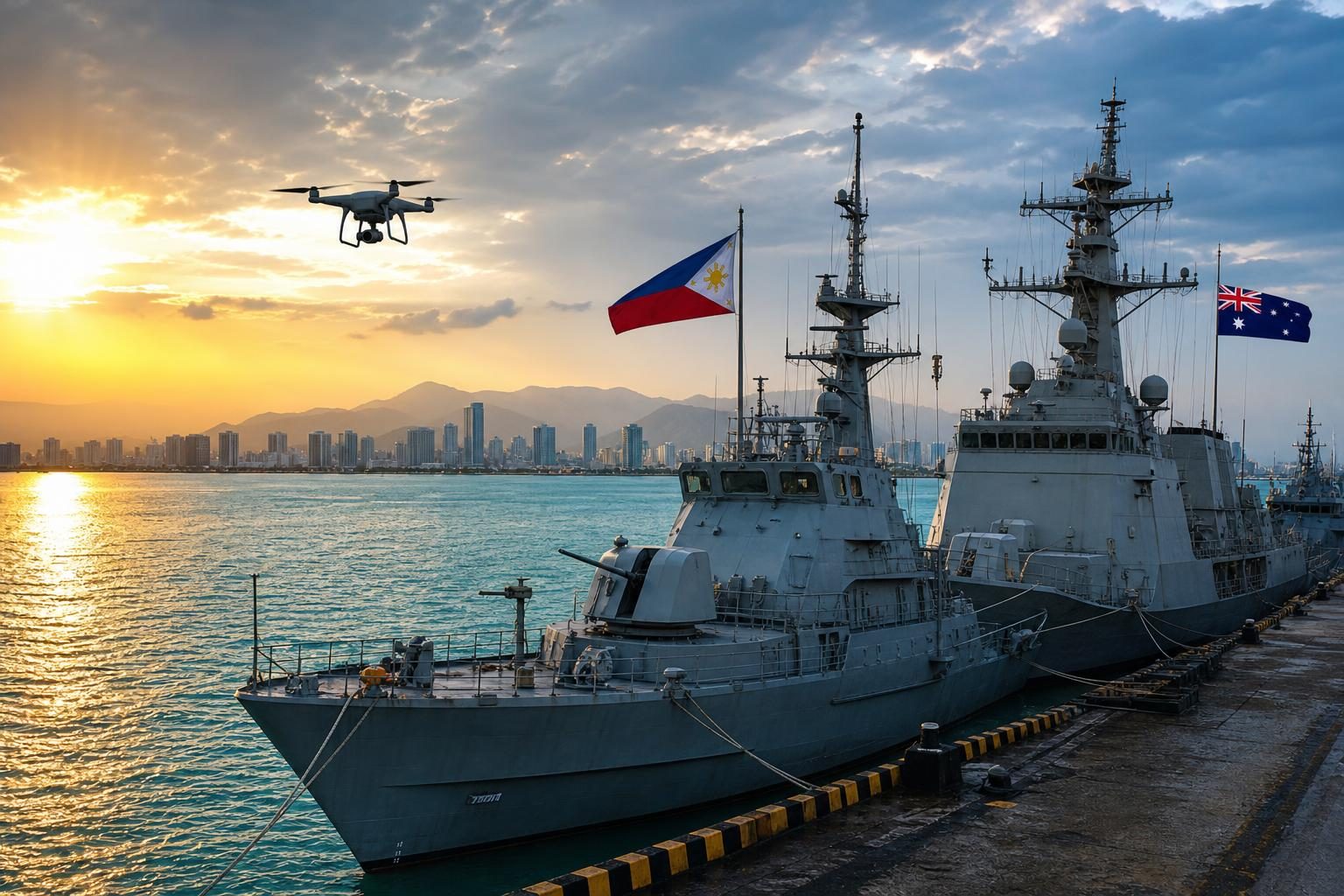
Illustration · Liberty Bell Report
Two of America's closest friends in the Pacific tightened their military partnership on Sunday, and they did it in plain view of the region's leaders. Philippine Defense Secretary Gilberto Teodoro Jr. and Australian Ambassador Marc Innes-Brown signed a new Defense Cooperation Arrangement in Manila, with Australian Prime Minister Anthony Albanese witnessing the signing at Manila's South Harbor ahead of the 49th summit of the Association of Southeast Asian Nations, The Manila Times reported.
The timing was deliberate. Southeast Asia's leaders opened three days of meetings in Manila on Sunday, and the agenda is dominated by the same pressure that drove Canberra and Manila together: an increasingly assertive China pushing its claims across the South China Sea. And on Tuesday, President Trump is scheduled to land in Manila with Secretary of State Marco Rubio, according to the Philippine Star.
What the New Arrangement Does
Teodoro described the arrangement as an anti-red-tape measure that will make it far easier to carry out the two countries' existing Status of Visiting Forces Agreement, Reuters reported in a story carried by Philstar's Interaksyon. He put it simply: "Rather than 100 steps to do a single thing," the work will now take about 10.
That may sound like paperwork, but in a crisis paperwork is the difference between a ship that sails today and one that sails next month. The arrangement covers cooperation among maritime, air and land forces, as well as humanitarian assistance and disaster response, The Manila Times reported. Teodoro said it would strengthen the Philippines' credible deterrence posture, including in the South China Sea.
Australia's Deputy Prime Minister and Defense Minister, Richard Marles, said the agreement would deepen practical cooperation between the two militaries, with a focus on expanding maritime activities, sharing information and developing defense infrastructure, according to reports from Manila. The new deal builds on a statement of intent on enhanced defense cooperation that Teodoro and Marles signed on Aug. 22, 2025.
Drones and Eyes on the Water
The most concrete piece is surveillance. Albanese announced additional Australian support for the Philippines' maritime domain awareness, including drone technology, equipment and training aimed at spotting maritime and cyber threats, Reuters reported. Earlier Australian support for the Philippine Coast Guard already topped $13 million, much of it in drones and the training to fly them.
That matters because the contest in the South China Sea is fought less with missiles than with presence. Chinese coast guard and maritime militia ships have spent years crowding Philippine vessels near disputed shoals, and Manila's best answer has been to see more, record more and show the world what is happening. Drones and trained operators are exactly the kind of help that lets a smaller nation defend its rights without firing a shot.
Beijing's Shadow Over the Summit
China was not at the signing table, but it was in every conversation. Beijing routinely objects to Manila's joint military activities with its allies, arguing that such drills raise tensions, Reuters noted. Australia, for its part, backs the 2016 international arbitral ruling that rejected Beijing's sweeping maritime claims, a decision China refuses to accept.
Albanese pushed back on the idea that the agreement was designed to counter China's growing military reach, and he said Australia would continue its freedom-of-navigation activities despite repeated criticism from Beijing. Diplomacy aside, the message is unmistakable: the countries that live closest to China's expanding navy are building a web of partnerships so that no single neighbor stands alone.
Philippine President Ferdinand Marcos Jr. used his opening remarks to press the bloc to advance an effective South China Sea code of conduct grounded in international law, including the U.N. Convention on the Law of the Sea, ANI reported. But analysts told Al Jazeera that finishing the long-delayed code will be a tall order, and a final pact is unlikely to come out of this summit. ASEAN and China have been negotiating for years, and Beijing has resisted making any agreement legally binding on the terms Manila wants.
Trump's Manila Stop and the Quad
The American piece of the puzzle arrives Tuesday. Philippine Ambassador to Washington Jose Manuel Romualdez confirmed that Rubio will join the president, and said Rubio will also take part in a Quad leaders' meeting on the sidelines, the Philippine Star reported. The Quad brings together the United States, India, Japan and Australia, and the Manila meeting would be the first Quad summit of Mr. Trump's second term. After Manila, the president and Rubio are expected to fly on to Shenzhen, China, for the Asia-Pacific Economic Cooperation summit.
That itinerary sets up a striking contrast. In Manila, the president will meet the allies who are lining up to resist Chinese pressure at sea. In Shenzhen days later, he will sit down with China's own leader. For a president whose foreign policy rests on negotiating from strength, the order matters: walking into the room with Beijing after standing with the Quad and a newly reinforced Philippine-Australian partnership sends a clear signal about who has friends in the region.
Why It Matters to Americans
The United States has a mutual defense treaty with the Philippines dating to 1951, and American forces rotate through Philippine bases under agreements both countries have expanded in recent years. Every step Australia takes to share the burden of deterring China is a step that makes the American commitment more credible and less lonely.
Australia's move also fits a wider pattern. Japan signed its own reciprocal access agreement with the Philippines in 2024, and the United States has expanded the number of Philippine bases its forces can use under the Enhanced Defense Cooperation Agreement. Each of these deals is modest on its own. Together they form a lattice of partnerships that makes it much harder for Beijing to isolate and pressure any one country, and much easier for free nations to respond together when a crisis comes.
This is how peace through strength works in practice. Allies who invest in their own defense, train together, and cut the red tape that slows a response are allies who make war less likely, not more. Teodoro's point about 100 steps becoming 10 is the kind of practical improvement that rarely makes headlines but can make the difference when a coast guard cutter is surrounded at sea.
It also matters for American workers and families. The South China Sea carries a vast share of the world's trade, including the electronics, parts and goods that fill American stores and the components American factories depend on. A sea lane governed by international law is good for American commerce; one governed by intimidation is not. If Beijing can decide who fishes, drills and sails in those waters, it gains leverage over every economy that depends on them, including ours.
What Comes Next
The ASEAN meetings run through Tuesday, when the Philippines is set to hand the bloc's rotating chairmanship to Singapore. Watch for whether the leaders' final statement says anything new about the code of conduct, and whether Beijing responds publicly to the Australia-Philippines arrangement.
Then the focus shifts to the president. A Quad meeting in Manila, followed by talks in Shenzhen, will test whether Washington can rally its friends and press its rival in the same week. For the Philippines and Australia, Sunday's signing was their answer to that test: they are not waiting to be asked.
Sources
- The Manila Times: PH, Australia sign defense cooperation (link)
- Interaksyon (Philstar): Philippines, Australia sign defense pact with eye on China (link)
- ANI: ASEAN Summit: Australia, Philippines sign landmark Defence Cooperation Agreement (link)
- Al Jazeera: Pact on South China Sea code of conduct unlikely, as ASEAN leaders gather (link)
- ANI: ASEAN must advance effective South China Sea Code of Conduct under international law: Philippine President Marcos (link)
- The Philippine Star: Rubio to accompany Trump in Manila (link)
— 30 —