History & Culture
Faith, Fields and Longleaf Pine: Jimmy Carter's Family Farm Is Preserved for Georgia
A conservation nonprofit has bought about 2,458 acres of Carter family farmland and an adjoining tract near Plains, Georgia, and plans to open it for hunting and fishing as soon as 2027.
By JACK HOLLISTERStaff Correspondent · GEORGIA · Nov 12, 7:00 PM · 6 min. read
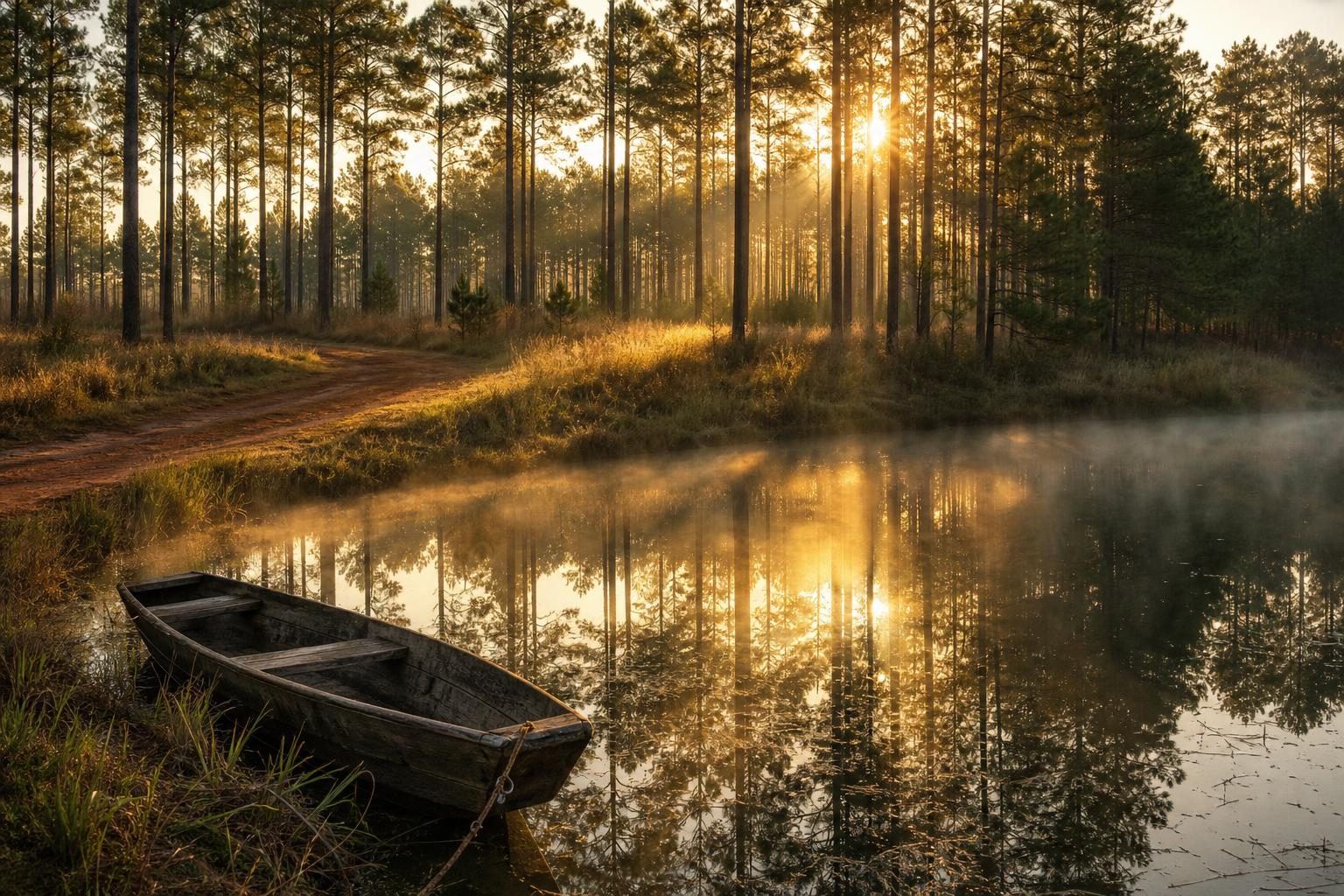
Illustration · Liberty Bell Report
A stretch of old farm fields, ponds and pine woods west of Plains, Georgia, the ground that shaped the 39th president, is headed into public hands. The Conservation Fund announced Monday that it has acquired roughly 2,458 acres that include the farm where Jimmy Carter worked as a boy, and it plans to open the property for hunting, fishing and other outdoor recreation as soon as 2027. The land will be folded into the neighboring Lanahassee Creek Wildlife Management Area, growing it to nearly 7,000 acres. The Associated Press, citing The Washington Post, put the purchase price at $8.5 million.
It is a fitting outcome for land Carter kept returning to his whole life. He died in December 2024 at 100, a little more than a year after his wife, Rosalynn. And it is a reminder that the most lasting conservation often starts not with a mandate from Washington but with a family deciding what its land should be for.
Which Carter Land This Is
Some confusion is understandable, because Plains already has a Carter farm that welcomes visitors. The National Park Service operates the Jimmy Carter Boyhood Farm in the community of Archery, about two miles west of town, where Carter lived from age four until he was 18. The Atlanta Journal-Constitution reported that the new purchase leaves that smaller parcel untouched; it remains open and part of Jimmy Carter National Historical Park.
What changed hands is the larger working landscape. According to the AJC, about 1,600 acres are former Carter farmland in Webster County, west of Plains, while the rest came from a neighboring landowner, and the paper put the combined price at about $8 million.
As for the sellers, the AJC reported that the Carters' children had explored a sale, and the Fund agreed to buy the land and hold it until the state was ready to take it. Stacy Funderburke, the Fund's vice president for the central Southeast region, told the paper that government agencies cannot always move as fast as a real estate deal requires. Blake Sullivan, a forestry consultant who helped Carter manage the land for decades, told the AJC the family had cared for the property well and could have sold it to anyone, but wanted its legacy and stewardship protected.
Who Will Run It and What Will Open
The Fund will own and care for the land until it transfers the property to the Georgia Department of Natural Resources in 2028, with public access expected to begin before that handoff. The Fund also helped the state create the Lanahassee Creek area in 2019 to protect longleaf pine forest and gopher tortoise habitat.
That habitat is the heart of the project. The gopher tortoise, Georgia's state reptile and a threatened species, depends on open longleaf pine forest, and its burrows give shelter to many other animals. The Carter property also supports deer, wild turkey and quail. At Carter's request, the family preserved a stand of mature longleaf pines, and in one of his final land-management decisions much of the rest was replanted with young longleaf.
Lee Taylor, chief of game management for the Department of Natural Resources, called the purchase "of huge historical significance for the state of Georgia". Speaking for the family, grandson Jason Carter said in a statement, "For our family, this land was always about more than a farm," and thanked the Fund and everyone working to protect it for future generations.
A Boyhood Among Peanuts, Corn and Cane
Carter was born in Plains on Oct. 1, 1924. His father, Earl, raised peanuts, corn and sugarcane on the land now being protected, and young Jimmy worked its fields and roamed the surrounding woods. At the home place in Archery, the Park Service recounts, he labored beside his father and the family's sharecroppers in peanuts, cotton, sugarcane, corn and other row crops. The New Deal conservation programs of those years, which helped farmers hold their topsoil, fight wildfires and plant pines, left him convinced, as the Park Service tells it, that land treated well will in turn provide for the people who depend on it.
The woods never let go of him. The AJC described a devoted turkey hunter who read tracks in sand and mud, practiced his calls by listening to recordings of champion callers and once brought down an 18-pound bird. As an adult, AP reported, he came back time and again with Rosalynn to walk and hunt, and near the end of his life he made one last fishing trip to the farm's pond. After his years in the Navy, he had come home to Plains to run the family business, and the AJC notes he became known far and wide as a peanut farmer.
A Sunday School Teacher First
For Carter, faith was never a campaign prop. He said he had been teaching Bible lessons since he was an 18-year-old midshipman at Annapolis, and he kept teaching at Washington's First Baptist Church while in the White House, making him the only president to teach Sunday school in office, Religion News Service reported, citing the White House Historical Association. Back home, he taught at Maranatha Baptist Church in Plains. His longtime aide Steven Hochman said in 2019 that Carter had taught more than 2,000 lessons, and historian Bill Leonard counted the teaching vocation at some 60 to 70 years. In 2014 Carter described his church home plainly: "that's where I teach Sunday school every Sunday". The modest sanctuary seats 300, yet it once drew a crowd of 878 to hear him.
In 1976 he campaigned openly as a born-again Baptist and won the votes of many evangelical Christians; with Ronald Reagan's election four years later, RNS noted, that bloc moved to the Republican Party. Carter also broke publicly with the Southern Baptist Convention after it revised its statement of faith on wives' submission and women as pastors, a dispute in which many traditional believers side with the convention, yet he kept worshiping at Maranatha. Even R. Albert Mohler Jr., president of the Southern Baptist Theological Seminary, said in 2019 that history would record no president with a greater long-term commitment to identifying with the Christian faith and teaching the Bible.
Rosalynn, his wife of 77 years, died at 96 on Nov. 19, 2023. Carter died at his home in Plains on Dec. 29, 2024, surrounded by family.
Hammers, Nails and Neighbors
The Carters' faith also found its way into work boots. They first volunteered with Habitat for Humanity in nearby Americus in March 1984, and later that year joined a crew renovating an abandoned building on New York's Lower East Side, the first of what became the Jimmy and Rosalynn Carter Work Project, and they kept at it every year until 2019. Habitat, which calls itself a Christian housing organization and traces its roots to an interracial community farm in south Georgia, says the project drew more than 108,000 volunteers in the United States and 14 countries and built, renovated or repaired 4,447 homes. Its chief executive, Jonathan Reckford, credited the couple with putting Habitat on the map and said the organization's prayers were with the family.
Stewardship as a Calling
The Park Service traces Carter's love of the outdoors to his religious convictions and close family ties, noting that his church taught him "the doctrine of stewardship, taking care of God's gifts". That lesson ran through his public life, from the 1980 Alaska lands law that The Conservation Fund says protected more than 104 million acres to the 39 national park units he established. At home, after 1981, the Carters ran their own acreage under a plan balancing productivity, wildlife, recreation and good stewardship, and it became a certified Tree Farm.
Readers who seldom shared Carter's politics can still recognize what happened here. A willing family, a private nonprofit and a state wildlife agency found a way to keep a cherished landscape whole, restore native longleaf forest and open it to the hunters, anglers and families of Georgia. The earth is the Lord's, as the psalmist wrote, and we are only its caretakers for a season. Carter, a peanut farmer who taught Scripture for most of his long life, seems to have believed that to the end, right down to his decision to replant much of the property with young longleaf.
Until the gates open, visitors to Plains can still walk the Boyhood Farm in Archery, where his love of the land first took root.
Sources
- ABC News (Associated Press): Jimmy Carter's family farm to be preserved and opened to the public (link)
- The Conservation Fund: Georgia Farm That Shaped Jimmy Carter Protected for Wildlife and Recreation (link)
- The Atlanta Journal-Constitution: Jimmy Carter loved turkey hunting. Soon his hunting land may be open to you. (link)
- National Park Service: Jimmy Carter's Beliefs on Stewardship (link)
- Baptist Standard (Religion News Service): Jimmy Carter, beloved Sunday school teacher, ex-president, dead at 100 (link)
- Habitat for Humanity: Habitat for Humanity mourns the death of former U.S. President Jimmy Carter (link)
— 30 —