Faith & Religion
Lit by Children Fighting Cancer: The Vatican's Christmas Tree Will Honor St. Francis in the 800th Year Since His Death
A white fir from Basilicata arrives in St. Peter's Square this week. On Dec. 7 it will light up at the same moment as Gubbio's giant tree, capping a jubilee year that has drawn hundreds of thousands of pilgrims to Assisi.
By MARGARET CALLAHANStaff Correspondent · WASHINGTON · Nov 18, 3:00 PM · 5 min. read
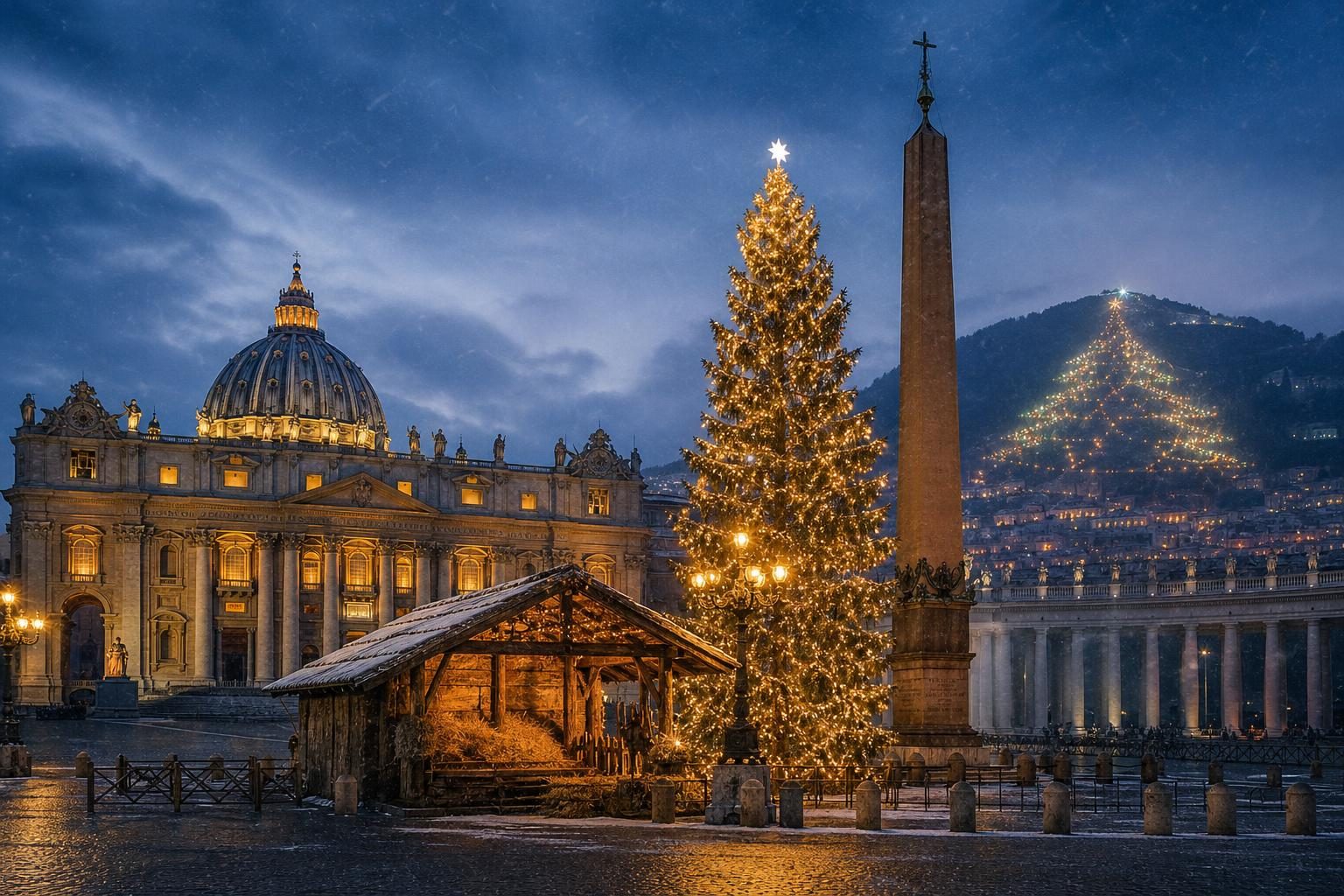
Illustration · Liberty Bell Report
A tall white fir from the mountains of southern Italy arrives in St. Peter's Square this week, and when its lights come on next month, the hands on the switch will belong to children fighting cancer. The Vatican's 2026 Christmas tree will be lit on Dec. 7 by children receiving treatment for cancer, at the same moment the famous tree in the Italian town of Gubbio is lit, Catholic News Agency reported.
The pairing is deliberate. This is the Year of St. Francis, the 800th anniversary of the death of the poor man of Assisi, and the Vatican has built this year's Christmas lighting around him. In a season when headlines are full of war, outages and political fights, it is a gentle reminder that the Church still marks time by the saints, and that the weakest among us are often given the place of honor.
A Tree From the Mountains of Basilicata
The tree is a white fir standing about 79 feet tall, cut from the Cugno dell'Acero forest in the southern Italian region of Basilicata, according to Catholic News Agency, which said it was due to arrive in Rome on Nov. 19. Aleteia, previewing the arrival, described the tree as coming to the Vatican "with a St. Francis twist".
The lighting itself will be a first. According to the Vatican City State's announcement, as reported by Vatican News, children receiving cancer treatment will switch on the tree in St. Peter's Square at 5:30 p.m. Rome time on Dec. 7 through a live link with Gubbio, and the two trees will be lit at the same time for the first time in history. The Nativity scene in the square will be unveiled alongside the tree that evening, Vatican News reported.
For American families following along, 5:30 p.m. in Rome is 11:30 a.m. on the East Coast, a Monday morning in the second week of Advent.
Why Gubbio, and Why a Wolf
Gubbio is not a random partner. According to tradition, it is the town where St. Francis tamed a fierce wolf that had been terrorizing its people, Catholic News Agency noted. Generations of Catholic children have grown up on that story of the saint going out to meet the animal and making peace between the wolf and the frightened town.
The town is also famous for its Christmas display. Gubbio's tree has held the Guinness title as the largest Christmas tree in the world since 1991, according to Catholic News Agency. Joining the two lightings links the center of the universal Church with a small Umbrian town whose most famous story is about peace.
The Saint Who Gave Us the Manger Scene
There is a deeper reason St. Francis belongs at the heart of Christmas. He is credited with creating the first Nativity scene, Aleteia noted. Franciscan Media's chronology of his life dates that first crèche to Christmas 1223 at Greccio, a hill town in central Italy.
The rest of his life followed in quick succession, according to the same chronology. In 1224, while praying on Mount La Verna, Francis received the stigmata, the wounds of Christ. He died on Oct. 3, 1226. Eight centuries later, the simple scene he arranged at Greccio so ordinary people could see the poverty and humility of the Christ Child is repeated in churches, front yards and living rooms around the world every December.
That is worth remembering in an age that often treats Christmas as a shopping season. The manger scene began as a sermon without words. Francis wanted people to see with their own eyes that God came to earth not in a palace, but in a feed trough, among animals, to a poor young mother and a carpenter.
A Year of Pilgrims and Mercy
Pope Leo XIV proclaimed a special Franciscan Jubilee Year running from Jan. 10, 2026, to Jan. 10, 2027, EWTN News reported. The Apostolic Penitentiary attached a plenary indulgence to the year under the usual conditions of sacramental confession, Holy Communion and prayer for the pope's intentions, and the faithful can receive it by making a pilgrimage to a Franciscan church or a place of worship dedicated to St. Francis anywhere in the world. The sick, the elderly and those who care for them can share in it by joining the jubilee celebrations spiritually, EWTN reported. The pope's letter announcing the year was dated from Assisi and placed peace at its center.
Catholics took the invitation seriously. Earlier this year, the remains of St. Francis were placed on public view in Assisi, and more than 370,000 pilgrims came to venerate them, Catholic Culture reported. Before this year, the saint's bones had been shown to the public only once in eight centuries, for a single day in 1978, according to the same report.
Those numbers tell a story the culture often misses. At a time when many commentators describe faith as fading in the West, hundreds of thousands of ordinary people traveled to a small hill town in Umbria to pray before the bones of a man who owned nothing. The Year of St. Francis has not been a museum exhibit. It has been a pilgrimage.
What It Means for Families This Advent
The choice of who lights the tree may be the most Franciscan part of the whole plan. Francis spent his life among lepers, beggars and the forgotten. Putting children in cancer treatment at the center of the Vatican's Christmas celebration, and linking them by video with the town of the wolf, fits a saint who believed the lowly and the suffering were close to the heart of Christ.
It also carries a message for families here at home. Christmas is coming in a year of real strain for many households, and the season can easily become one more source of stress. The Franciscan answer is not to spend more, but to look again at the manger. Jesus said that whatever we do for the least of his brothers and sisters, we do for him. Francis took that literally, and the children who will press the button on Dec. 7 are a living reminder of it.
There are simple ways to join in. Families can set up their own Nativity scene this year as a household act of prayer, and let the children place the figures. Parishes named for St. Francis, and Franciscan churches across the country, are places where Catholics can make the jubilee pilgrimage the Church has offered. And for those who cannot travel, the jubilee's provision for the sick and elderly is a reminder that no one is left out.
The theme the pope chose for the year matters, too. His letter opening the jubilee put peace at its center, and the story of Gubbio is a story about peace: a frightened town and a dangerous creature reconciled by a man armed with nothing but faith. In a year when Americans have watched war in the Middle East and Ukraine and bitter fights at home, the Church is offering a different picture, one that begins at a manger and asks every family to be a little more like the saint who built the first one.
Next month, a fir tree from Basilicata will glow above St. Peter's Square while a mountainside in Gubbio lights up at the same moment. Somewhere in between, a child in a hospital bed will help make it happen. Eight hundred years after Francis built a manger at Greccio to help people see the Christ Child, that may be the most fitting tribute of all.
Sources
- Catholic News Agency: Christmas tree lighting at Vatican to honor 800th anniversary of St. Francis of Assisi (link)
- Vatican News: Christmas tree in St. Peter's Square to be lit up on December 7 (link)
- Aleteia: Vatican's Christmas tree arrives tomorrow, with a St. Francis twist (link)
- EWTN News: Leo XIV proclaims Franciscan Jubilee Year and grants plenary indulgence (link)
- Catholic Culture: 370,000 pilgrims venerated St. Francis of Assisi's relics during unprecedented exposition (link)
- Franciscan Media: Chronology of the Life of St. Francis (link)
— 30 —