Energy & Environment
Inside the Senate's Permitting Deal: What the Bipartisan Energy Bill Would Change, and Why the Clock Is Ticking
The Senate cleared a key 73-25 hurdle on a sweeping bill to speed approvals for pipelines, power lines and power plants, cap lawsuits and make data centers pay their share of the grid. With Democrats taking over Congress in January, supporters have weeks to get it done.
By AVA STERLINGStaff Correspondent · MAINE · Nov 11, 7:00 PM · 5 min. read
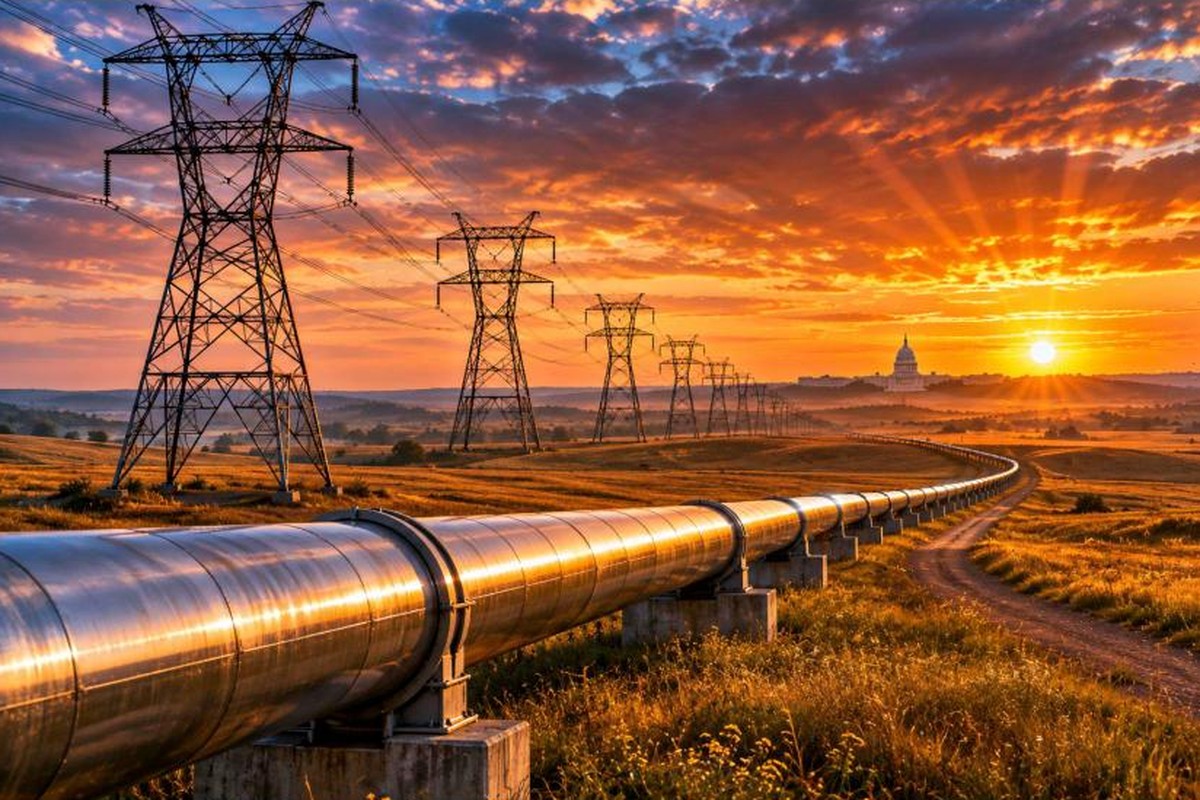
Illustration · Liberty Bell Report
For years, Republicans and Democrats have agreed on one thing about American energy: it takes far too long to build anything. This week, the Senate took its biggest step in a generation toward doing something about it.
On Monday, the Senate voted 73-25 to move forward on a sweeping permitting overhaul, the Bipartisan American Affordability and Jobs Act, according to the official roll call. Fifty-one Republicans and 21 Democrats voted yes, along with independent Sen. Angus King of Maine; Republican Sen. Mike Rounds of South Dakota, 23 Democrats and independent Sen. Bernie Sanders of Vermont voted no.
The bill was introduced on Sept. 30 by Sen. Shelley Moore Capito, the West Virginia Republican who chairs the Environment and Public Works Committee, with Republican Sen. Mike Lee of Utah and Democratic Sens. Martin Heinrich of New Mexico and Sheldon Whitehouse of Rhode Island, The Daily Caller reported. A revised version was released on Nov. 7.
What the Bill Would Do
At its core, the bill tries to make federal decisions faster and harder to tie up in court.
Under the National Environmental Policy Act, the law that requires federal environmental reviews, the bill would require a final decision on a project within 45 days of a final environmental impact statement, and would give agencies 90 or 120 days to issue other permits, according to the Bipartisan Policy Center. Current law already sets one-year and two-year targets for environmental assessments and full impact statements.
The biggest change may be in the courtroom. Instead of the six-year default window to file a lawsuit against a federal permit, challengers would get 150 days, the same limit in the House-passed SPEED Act, the center reported. Only people who commented during the review and can show direct harm could sue, and if a court finds a flaw in a review, it could send the permit back to the agency to fix while the permit stays in effect.
The bill also offers what supporters call permit certainty. Agencies could not revoke permits in effect on or after Nov. 6, 2026, except in six specific circumstances, and developers could seek damages for bad-faith interference. That provision is aimed squarely at the kind of political whiplash that has seen projects approved by one administration and canceled by the next.
Power Lines, Pipelines and Data Centers
The bill reaches into the guts of the power grid. It would allow the Federal Energy Regulatory Commission to approve high-voltage transmission lines of 230 kilovolts or more if a state fails to act within a year, and it would write FERC's regional grid-planning rule, known as Order 1920, into law, with costs shared according to who benefits.
For natural gas, upgrades to pipelines within existing corridors would be exempt from NEPA review, and states' reviews of projects under Section 401 of the Clean Water Act would be narrowed.
And in a nod to the artificial intelligence boom, the bill would require FERC, within 90 days, to change its pricing rules so that data centers pay their share of grid costs, plus the costs they cause. The latest version also dropped a size threshold that would have limited which data centers were covered.
That provision matters to ordinary ratepayers. When a giant new data center plugs into the grid, someone has to pay for the new lines and substations that serve it. Supporters of the bill want that someone to be the tech company building the facility, not the family down the road paying a monthly electric bill.
Why Permitting Matters
The case for reform is written in the government's own numbers. The White House Council on Environmental Quality found that the median time from the start of a federal environmental impact statement to its completion was 2.8 years for statements finished from 2019 to 2024, and 3.2 years for those finished from 2010 to 2018. The average time from the start of the process to a final decision was 3.8 years from 2021 to 2024, an improvement from 4.5 years between 2010 and 2018. To be fair, the same report found that 41% of the impact statements completed in 2024 took two years or less, which shows that faster reviews are possible when agencies make them a priority.
And those figures cover only the review itself, not the lawsuits that can follow anywhere within the current six-year window to sue. Every year of delay adds cost to a project, and in the end those costs land on Americans' electric bills.
The Wind Fight
President Trump has pushed hard for the bill. He urged the Senate to pass it before Democrats take control of Congress, saying it "will codify our America First Energy Agenda," The Daily Caller reported.
But he also complicated the coalition. On Monday, Trump said he backs the bill 100 percent, then added, "No, I will not approve wind turbines," The Hill reported. That remark cost at least one Democratic vote: Sen. Adam Schiff of California said he voted no because of it, Utility Dive reported.
The Opposition
Environmental groups remain unconvinced. The Sierra Club said "major substantive issues remain," and a coalition of tribal leaders said the Nov. 7 changes, which addressed tribal consultation and FERC's powers, did not go far enough, Utility Dive reported. The National Wildlife Federation said it cannot support the bill in its current form, The Daily Caller reported. Democratic Sens. Cory Booker of New Jersey and Jeff Merkley of Oregon were among those voting no.
On the other side, the American Petroleum Institute led a letter urging Congress to pass the bill in the lame-duck session, joined by the American Gas Association, refiners, the clean-energy group ClearPath and the Heritage Foundation, according to The Daily Caller.
The Clock
Supporters are racing the calendar. Democrats won both chambers of Congress on Nov. 3, and the new majorities take over in January. The bill is moving as an amendment to a House-passed tax bill, and after the Senate acts, the House must still pass it, The Daily Caller reported. Analysts at TD Cowen have cut their odds of the bill becoming law to about 25%, Utility Dive reported.
The Anchor's Take
This is the kind of bill Washington almost never produces anymore: a real compromise, written by members of both parties, that tries to fix a problem every American pays for. It is not perfect. Conservatives can fairly question giving federal regulators more power to override states on transmission lines, and the tribal nations whose lands these projects cross deserve to be heard, not steamrolled.
But the core of the bill is common sense. A country that wants affordable power, more domestic energy and a grid ready for the next generation of factories and data centers cannot keep taking the better part of three years just to finish a federal environmental review and then face six more years of lawsuits. The Senate should finish the job, and the House should take it up before the clock runs out on this Congress.
What comes next: debate and amendment votes continue on the Senate floor, with final passage possible within days or weeks. Then the action shifts to the House, where the window closes when the new Congress is sworn in.
Sources
- U.S. Senate: Roll Call Vote 257, 119th Congress, 2nd Session (link)
- Bipartisan Policy Center: Explaining the Senate Permitting Bill, the Bipartisan American Affordability and Jobs Act (link)
- Utility Dive: Permitting bill advances in Senate, but election results cast doubt on its future (link)
- The Daily Caller: Trump Pushes To Speed Pipeline, Power Plant Approvals Before Democrats Take Over (link)
- The Hill (via Yahoo News): Trump says he 'will not approve wind turbines' despite support for permitting reform bill (link)
- Council on Environmental Quality: Environmental Impact Statement Timelines Report (link)
— 30 —