Education
Can Colorado Shut Catholic Preschools Out of Universal Pre-K? The Supreme Court Case Families of Faith Are Watching
In St. Mary Catholic Parish v. Roy, Denver-area parishes say the state made them choose between their beliefs and a program open to other preschools. Here's what the justices heard and what's at stake.
By HAROLD WHITMOREStaff Correspondent · WASHINGTON · Nov 12, 9:30 AM · 6 min. read
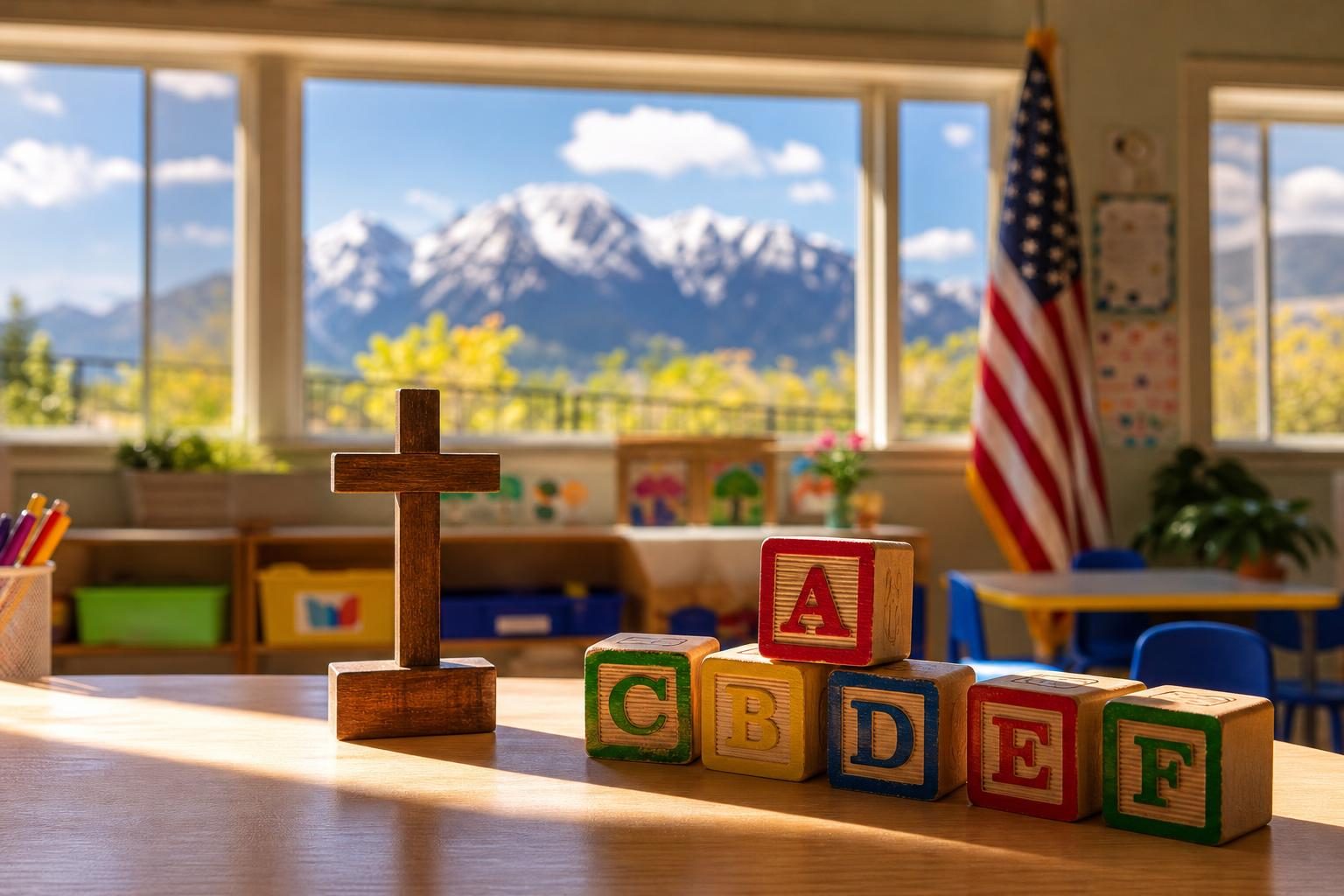
Illustration · Liberty Bell Report
Colorado promises free preschool to every child in the state in the year before kindergarten. The question now before the Supreme Court is whether it can keep that promise while shutting out Catholic parishes that run preschools in the Denver area.
The justices heard arguments on Nov. 3 in St. Mary Catholic Parish v. Roy, a religious-liberty dispute over Colorado's universal preschool program. Fox News reported that the court's conservative majority offered clear support for the Catholic preschools during a lively argument. A decision is expected in 2027, according to an analysis by the law firm Quarles & Brady.
Here is what the case is about, what the justices asked and why it matters for families of faith far beyond Colorado.
The Case in Brief
The challengers are St. Mary Catholic Parish and St. Bernadette Catholic Parish, which run preschools; the Archdiocese of Denver; and Daniel and Lisa Sheley, parishioners whose children attended the schools, according to Cornell Law School's Legal Information Institute. They sued Dr. Lisa Roy, executive director of Colorado's Department of Early Childhood, and Dawn Odean, the state's universal preschool director.
The court agreed to hear the case on April 20, 2026. Its docket number is 25-581.
At its heart, the dispute is simple. Colorado requires preschools that take part in its program to admit every family that applies, including LGBTQ children and children of LGBTQ parents, and the state refused to grant the Catholic schools an exemption, SCOTUSblog reported. The parishes say that being kept out of the program for following their faith is religious discrimination that the First Amendment forbids. Fox News reported that the parishes argue the program unconstitutionally targets their beliefs about same-sex marriage.
How Colorado's Program Works
Colorado voters approved state funding for preschool through Proposition EE, a 2020 ballot measure, and the legislature created the universal preschool program in 2022, according to the Legal Information Institute. The program guarantees up to 15 hours a week of tuition-free preschool in the year before kindergarten. Families can use it at public or private preschools, the National Constitution Center noted.
To take part, providers must sign an agreement promising equal enrollment opportunity regardless of sexual orientation, gender identity, religious affiliation and other characteristics.
But the rules are not quite as uniform as they sound. The program's matching system lets schools give priority to siblings, members of a congregation and certain communities, and it includes preferences tied to special-education plans, Head Start and a broader catchall category, the institute reported. The parishes argue that those exceptions show the state already makes room for some schools' priorities but refuses to make room for theirs.
What the Lower Courts Said
The Catholic schools lost twice before reaching the high court.
After a three-day trial, a federal district court in Colorado denied the parishes a permanent injunction, the Legal Information Institute reported. The judge found Colorado's requirement neutral and generally applicable, so the state did not have to meet the demanding test known as strict scrutiny.
The U.S. Court of Appeals for the 10th Circuit affirmed, holding that the requirement faced only rational-basis review, the most lenient standard in constitutional law. In other words, the courts below said Colorado needed only a plausible reason for its rule.
The Legal Fight: Smith Versus Carson
Two Supreme Court precedents frame the case.
The first is Employment Division v. Smith, the court's 1990 decision holding that neutral, generally applicable laws usually do not violate the Free Exercise Clause even when they burden religion. Under Smith, a law that is not truly neutral or that is riddled with exceptions faces strict scrutiny.
The second is Carson v. Makin, the 2022 decision in which the court struck down Maine's ban on using public tuition money at private religious schools. Carson built on a line of cases holding that once a state offers a public benefit, it cannot exclude religious schools because they are religious.
The court agreed to answer two questions, SCOTUSblog reported. The first is whether challengers must show unfettered government discretion or categorical exemptions for identical secular conduct to prove a law is not generally applicable under Smith. The second is whether Carson's protection applies only when a government explicitly excludes religious people and institutions.
Notably, the court will not decide whether Smith itself should be overturned, the National Constitution Center reported. The question is narrower, and in some ways more practical: can a state accomplish through admission rules what Carson forbids it to do through an outright ban?
What the Justices Asked
According to Quarles & Brady's account of the argument, several justices pressed Colorado on exactly that point.
Chief Justice John Roberts asked why it should matter that the Maine law in Carson expressly discriminated against religious schools, and he later observed that the effect of Colorado's rule was "pretty much the same as the effect of the law here," the firm reported. Justices Samuel Alito, Amy Coney Barrett, Neil Gorsuch and Brett Kavanaugh asked questions suggesting that Colorado was working around Carson, and that excluding religious schools indirectly should be treated the same as excluding them openly.
Kavanaugh appeared to accept the parishes' argument that the rule is not generally applicable, because the program exempts certain low-income and disability-based preferences, according to the firm. Justice Clarence Thomas noted that the court did not rely on Smith in its two most recent decisions on religious schools and public benefits. Gorsuch and Barrett observed that strict scrutiny would mirror the test that about 40 states already apply under religious-freedom laws.
The court's liberal justices saw the case differently. Justice Sonia Sotomayor challenged the parishes' claim that the church is not excluding anyone, and Justices Elena Kagan and Ketanji Brown Jackson suggested that a ruling for the schools would give religion a special status in tension with Smith, Quarles & Brady reported. Alito and Gorsuch, for their part, distinguished exclusions based on race or national origin, where strict scrutiny would clearly apply.
The case has drawn national attention. West Virginia and 20 other states filed a brief supporting the parishes, while Massachusetts, Minnesota, 16 other states and the District of Columbia backed Colorado, the Legal Information Institute reported.
Why It Matters for Families of Faith
For Catholic families, the stakes are practical. A preschool that cannot take part in a universal program competes against free alternatives with one hand tied behind its back, and parents who want a faith-centered education for their youngest children end up paying twice, once in taxes and again in tuition.
For the broader public, the stakes are constitutional. The First Amendment protects the free exercise of religion, not merely the freedom to believe in private. If a state can offer a benefit to everyone, then write the rules so that only schools willing to set aside their convictions may accept it, the promise of Carson would mean little. That is the argument the parishes brought to Washington, and based on the questions from the bench, a majority of the justices appeared to take it seriously.
Colorado's side deserves a fair statement, too. The state says it wants every family to have equal access to a program paid for by all taxpayers, and its rules apply to every participating preschool regardless of affiliation. The question is whether the Constitution permits that goal to be pursued in a way that leaves faithful Catholic schools on the outside.
What Comes Next
The justices will now deliberate, and a ruling is expected in 2027. Whatever the court decides will shape how states across the country design voucher, preschool and school-choice programs for years to come.
The case was one of seven the court heard in its November session, which also included disputes over federal prisoners' early-release credits and how to calculate just compensation when a pipeline company takes private land through eminent domain, SCOTUSblog reported.
Liberty Bell Report will cover the decision when it comes down.
Sources
- SCOTUSblog: Court hears argument in religious discrimination dispute (link)
- SCOTUSblog: Court announces cases it will hear in November, including religious discrimination dispute (link)
- Legal Information Institute, Cornell Law School: St. Mary Catholic Parish v. Roy (link)
- Fox News: Supreme Court offers support for Catholic preschools challenging state funding requirements (link)
- Quarles & Brady: Supreme Court Hears Oral Arguments on Religious Exemptions to LGBTQ Nondiscrimination Requirements (link)
- National Constitution Center: New Supreme Court term features First Amendment, other challenges (link)
— 30 —