Crime & Justice
Deputies Expected a Fentanyl Lab. In a Baton Rouge Basement, the DEA Says They Found the Nation's First Large-Scale Nitazene Operation
Testing showed nearly 58 liters of etonitazene in an industrial reactor, investigators say, as DEA chief Terry Cole warns the newest synthetic pills are deadlier than anything his agents have seen.
By ELIJAH CARTERStaff Correspondent · LOUISIANA · Nov 21, 6:39 PM · 3 min. read
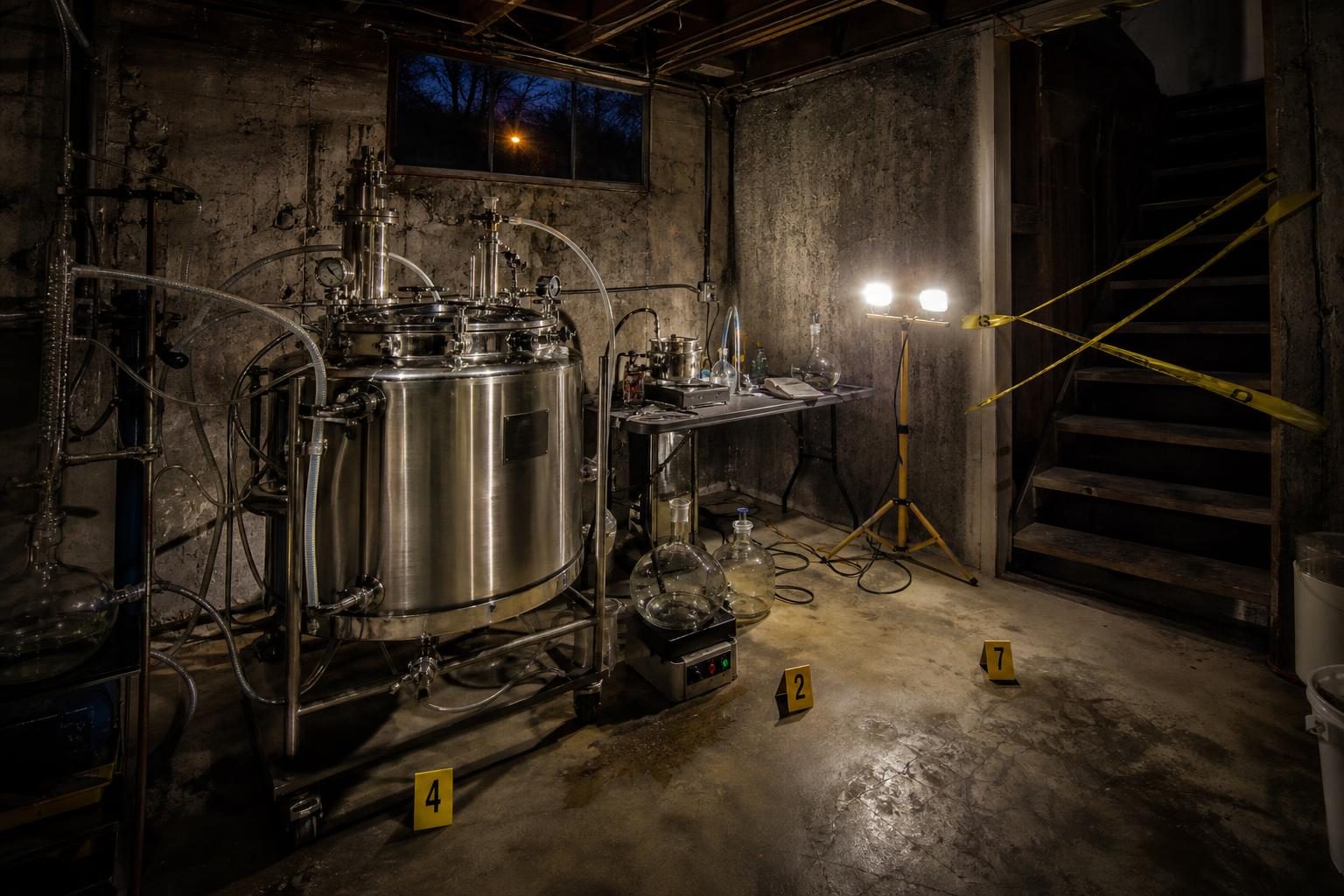
Illustration · Liberty Bell Report
Investigators in Louisiana thought they were chasing a fentanyl cook. What they found, the Drug Enforcement Administration says, was something newer and potentially deadlier.
The East Baton Rouge Parish Sheriff's Office and the DEA dismantled a clandestine laboratory in the basement of a Baton Rouge home that federal forensic testing confirmed was producing etonitazene, a member of the synthetic opioid family known as nitazenes. The DEA describes it as the first known large-scale domestic nitazene synthesis lab it has dismantled.
Inside the Basement
The case grew out of a three-month investigation that began when state police tied a suspect, Torrey Lewis Jr., to fentanyl distribution in New Orleans, according to local reporting. Deputies arrested Lewis on Nov. 12, and he is being held without bond. He is presumed innocent, and the allegations against him have not been proven in court.
What agents found was no kitchen-table operation. Investigators reported roughly $250,000 in professional-grade equipment, including a 100-liter industrial reactor system. About 58 liters of liquid sat in the main reactor vessel, and laboratory testing identified it as etonitazene, the sheriff's office said.
That detail is worth pausing on. Fentanyl reshaped the American drug trade because a tiny amount goes a very long way. Nitazenes push that math further. Newsweek described the drug found in Baton Rouge as an opioid stronger than fentanyl, and CBS News reported that nitazenes can be up to 80 times more potent.
Louisiana on the Front Line
The bust also helps explain a pattern the DEA has been watching. More than 80 percent of the etonitazene exhibits the agency seized nationwide this year came from Louisiana, the DEA reported. That figure reflects seizures, not total use, but it points to a supply line running through the state.
Earlier this year, DEA New Orleans warned Northshore communities about lethal synthetic opioids after a spike in overdoses, noting that the agency's forensic laboratories have identified more than 20 distinct nitazene compounds in recent years. The same warning said illicit chemists keep introducing new nitazene variants quickly, a cat-and-mouse game that leaves families and first responders guessing about what is in a pill.
'New Poison' and a National Warning
The Baton Rouge case landed as the DEA's top official delivered a blunt message. Administrator Terry Cole told CBS News that the newest synthetic opioids are deadlier than anything his agents have encountered, and he laid the blame on cartels chasing profit. "The cartels will exploit every avenue and every source possible," Cole said. Opioids are on pace to kill more than 35,000 Americans this year and remain the leading cause of death for adults ages 18 to 45, the CBS report said.
There is real progress to defend here. Federal and local officers working together found this lab and shut it down before more of its product could reach the streets of Baton Rouge and New Orleans. That is what coordinated law enforcement looks like when it is funded, staffed and allowed to do its job.
It is also a warning about where the fight is headed. The battle against synthetic opioids no longer runs only through the border and the ports. It runs through basements in American neighborhoods, where a chemist can swap one molecule for another faster than regulators can name it. Sheriffs, state police and federal agents who share information are the best answer to that kind of threat.
What Families Should Know
The most dangerous products in this new market look ordinary. Federal authorities have warned that powerful synthetic substances are being mixed into pressed pills, which can be made to resemble prescription painkillers or anxiety medication. The safest rule for every household is simple: take only medicine that comes from a licensed pharmacy with your name on the label, and talk with teenagers and college students about why a pill from a friend is never worth the risk.
Parents should also know that the threat is not limited to people struggling with addiction. A single counterfeit pill taken at a party or to get through finals week can be enough to change a family forever.
Anyone with information about drug dealing in their community can contact local law enforcement or the DEA. In Baton Rouge, the patient work of deputies and agents may have spared lives that no one will ever be able to count.
Sources
- CBS News: They thought it was a fentanyl lab. It was nitazenes, synthetic opioids up to 80 times more potent. (link)
- WBRZ: EBRSO, DEA dismantle synthetic opioid lab creating nitazene, a first in the US (link)
- WWL-TV: DEA dismantles first known large-scale nitazene lab in US at Baton Rouge home (link)
- CBS News: DEA says new synthetic pills are deadlier than they've seen before (link)
- DEA: DEA New Orleans Warns Northshore Communities of Lethal Synthetic Opioids Following Overdose Spike (link)
- Newsweek: What Are Nitazenes? DEA Lab Bust Uncovers Opioid Stronger Than Fentanyl (link)
— 30 —