
 Tonight on Health Check with Samuel Adeyemi
Congo's Ebola Toll Passes 5,700 as the WHO Keeps Its Global Emergency in Place and Trials Race for a Vaccine Against a Rare Strain
The Bundibugyo outbreak is now the largest in Congo's history. Kenya and Nigeria report no new cases, and the CDC still rates the risk to Americans as low.
Filed November 21, 2026 · 📍 Washington, DC 20001
Were you there? Share your story
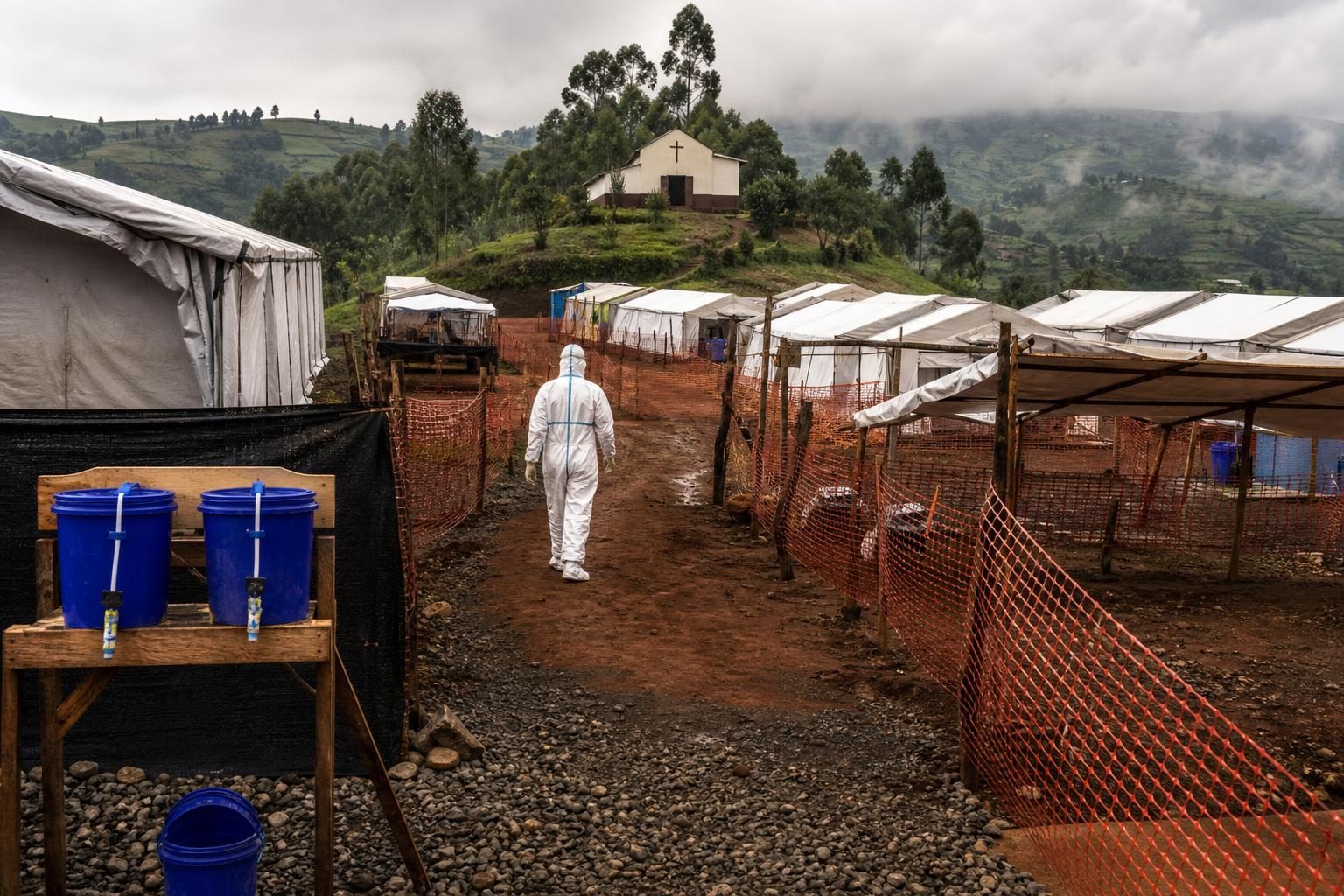
Part of our continuing coverage: Congo's Ebola Outbreak Passes 11,000 Cases, the Country's Deadliest Yet
Key points
- More than 11,700 confirmed cases and 5,700 deaths had been counted as of Nov. 19, TIME reported.
- The WHO's director-general determined on Nov. 18 that the outbreak is still a public health emergency of international concern.
- No vaccine or medicine is approved for Bundibugyo virus disease; an experimental mRNA vaccine is in an early safety trial.
- Kenya has started its 42-day countdown to declare its outbreak over, and Nigeria's contacts finished monitoring with no new cases.
The Ebola outbreak in the Democratic Republic of the Congo keeps growing. More than 11,700 confirmed cases and 5,700 deaths had been recorded as of Nov. 19, TIME reported, making it the largest and deadliest Ebola outbreak in the country's history and the second-deadliest anywhere [1].
TIME reported that the virus is spreading faster than Congo's health workers can respond, and that stopping it will take stronger frontline clinics, more community trust and a vaccine [1].
A Steady, Grim Climb
The numbers have climbed week after week. As of Nov. 15, the European Centre for Disease Prevention and Control counted 11,376 confirmed cases in Congo, including 5,568 deaths [2]. Earlier in the month, as of Nov. 3, the WHO had counted 10,668 confirmed cases, including 5,198 deaths and 2,881 recoveries [3]. Counts differ slightly by source and date, but the trend is plain: roughly 500 more deaths in a little over two weeks, and well over 100 in the four days between the ECDC's count and TIME's [1][2][3].
The outbreak is caused by Bundibugyo virus, one of the rarer members of the Ebola family [2][4]. Since it was declared on May 15, cases linked to it have been reported in five countries: Congo, France, Kenya, Nigeria and Uganda, according to the ECDC [2]. Uganda's outbreak, which the ECDC lists at 20 confirmed cases and two deaths, has since been declared over [2].
The World Health Organization Keeps the Alarm On
In its latest outbreak update, dated Nov. 20, the World Health Organization said its director-general determined on Nov. 18 that the event remains a public health emergency of international concern, its formal designation for a global health threat [4].
There was some better news outside Congo. The WHO said no new cases have been reported from Kenya or Nigeria, and no new country has reported a confirmed case [4]. Kenya, which has had nine confirmed cases and two deaths, discharged its last patient on Nov. 11 after two negative tests, released the remaining contacts from quarantine and began the 42-day countdown to declaring its outbreak over [4]. That waiting period equals two full 21-day incubation cycles, the standard health officials use before declaring an Ebola outbreak finished [4]. In Nigeria, which reported one case on Oct. 20, all 62 contacts finished their 21-day follow-up on Nov. 13 with no new infections [4].
No Approved Vaccine Yet
Part of what makes this outbreak so hard to stop is the strain itself. The Centers for Disease Control and Prevention says no vaccines or medicines have been approved for Bundibugyo virus disease [5].
Researchers are racing to close that gap. A Phase 1 trial registered with the U.S. National Library of Medicine is testing the safety and immune response of an experimental mRNA vaccine, mRNA-1469, against Bundibugyo virus disease in healthy adults, with an estimated completion date of September 2027 [6]. That timeline is a reminder that, for now, the front line in Congo still depends on the old tools: finding cases early, tracing contacts, isolating the sick and burying the dead safely.
What It Means for Americans
The CDC rates the overall risk to the general U.S. population as low, citing the extremely low likelihood of the virus spreading here, while noting that any infection would have a serious impact [5]. The agency said it was still assessing that risk as of Oct. 30, and its measures focus on keeping the virus from being imported [5]. The lesson of past outbreaks is that the surest way to protect Americans is to help stop the virus where it starts, through early detection, contact tracing and safe care on the ground. Travelers to the affected region should follow official health guidance before and after their trips.
For the people of eastern Congo, the risk is anything but low. Families there are burying loved ones in a region that has known little peace. The nurses, doctors and community health workers on the front line are doing dangerous work in clinics that need more support [1]. They deserve our attention, and our prayers, now more than six months into the outbreak [2].
Sources
- [1]Opens in a new tab ↗
- [2]European Centre for Disease Prevention and ControlEbola disease outbreak caused by Bundibugyo virusOpens in a new tab ↗
- [3]World Health OrganizationDisease Outbreak News: Ebola disease caused by Bundibugyo virus - Democratic Republic of the Congo, Kenya and Nigeria (Nov. 6 update)Opens in a new tab ↗
- [4]World Health OrganizationDisease Outbreak News: Ebola disease caused by Bundibugyo virus - Democratic Republic of the Congo, Kenya and NigeriaOpens in a new tab ↗
- [5]Opens in a new tab ↗
- [6]ClinicalTrials.govA Study to Investigate the Safety, Reactogenicity, and Immunogenicity of mRNA-1469 Vaccine to Prevent Ebola-Bundibugyo Virus Disease in Healthy Adult ParticipantsOpens in a new tab ↗
What worries you most about health care?
- Cost
- Getting an appointment
- Quality of care
- Government getting more involved
More in Health & Medicine
Put Down the Rinse, Pick Up the Thermometer: A Family Guide to a Safe Thanksgiving Table, From the Weekend Thaw to the Last Leftover
Tonight on Health Check with Samuel Adeyemi

Ohio Sends DeWine Two Bills Built Around Women's Safety: A 24-Hour Pause Before Abortion and an In-Person Visit for High-Risk Drugs
Today on Mother & Child with Elena Vasquez

Ditching Junk Food May Restore Some Memory, Animal Review Finds
Today on Heart of the Matter with Michael Grant
Were you there?
If you were at the scene, or this story touched your life, tell us what you saw and what it was like.
Discussion 0
Sign in or create a free account to join the discussion.
No comments yet. Start the discussion.