
 Tonight on Kitchen Table with Megan O’Brien
Salmonella in Butterball's Ground Turkey: The Inspection Numbers, the Company's Answer and the Kitchen Rules That Keep Thursday Safe
Inspection data reviewed by The Guardian found high salmonella rates in ground turkey at Butterball plants, but none in whole birds. Here is what the report says, and the simple steps that keep a holiday dinner safe.
Filed November 25, 2026 · 📍 Raleigh, NC 27601
Were you there? Share your story
Key points
- Inspectors found salmonella in more than a third of ground or chopped turkey samples at four Butterball plants, The Guardian reported.
- The review found no salmonella in Butterball's whole birds or ready-to-eat products, and no recall has been announced.
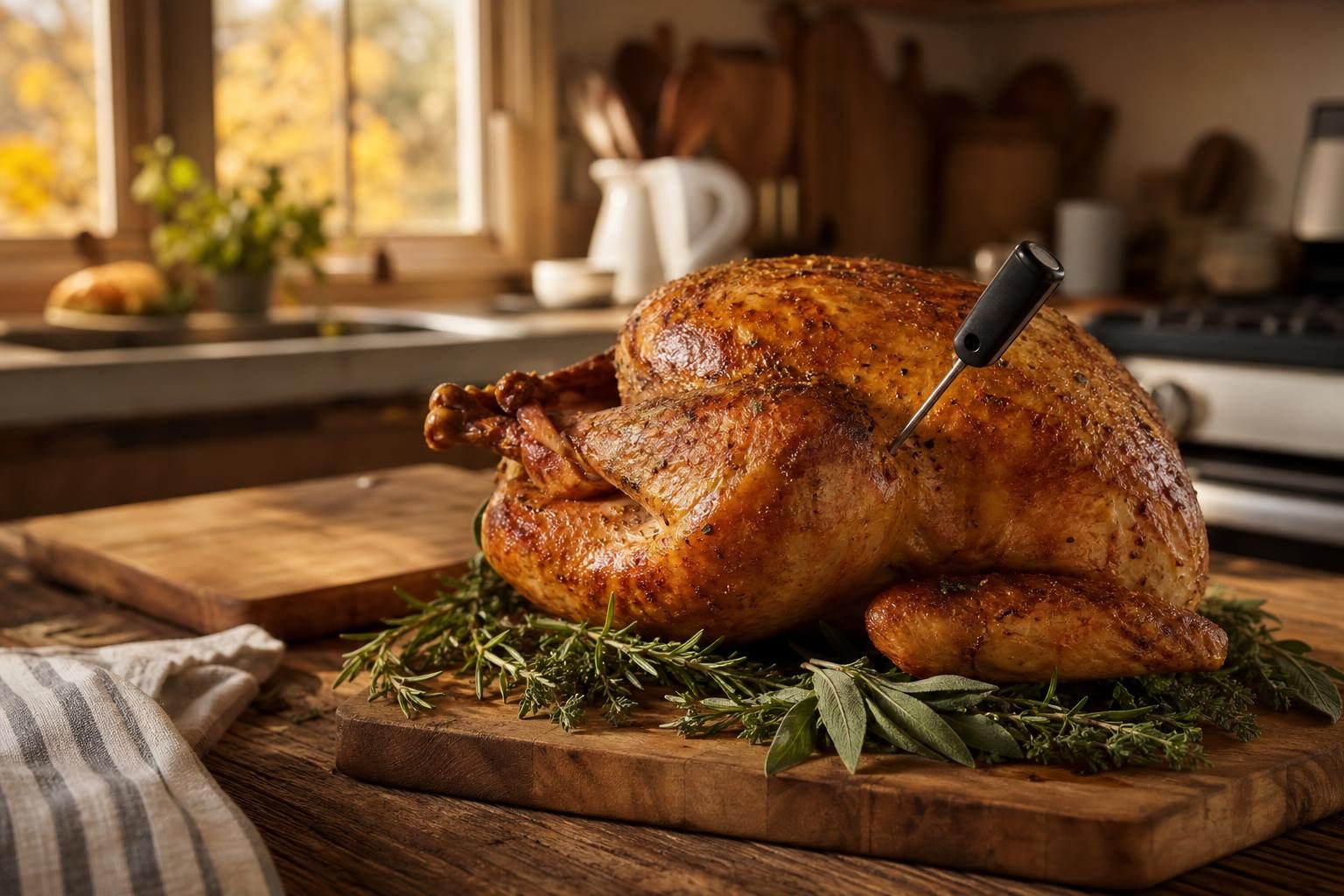
- USDA says turkey is safe at 165 degrees, checked with a food thermometer in the breast, thigh and wing.
- Thaw in the refrigerator, skip rinsing the bird and keep raw and cooked foods apart.
On the night before Thanksgiving, millions of families have a turkey thawing in the refrigerator or brining in a cooler. So a new report on salmonella at the country's biggest turkey company deserves a calm, careful read, along with a reminder of the simple kitchen habits that keep a holiday dinner safe.
What the report found
Federal inspectors found salmonella in more than a third of ground or chopped turkey samples taken at slaughterhouses owned by Butterball over two years of inspections at four plants, The Guardian reported on Wednesday [1]. The newspaper said the findings come from an analysis by the investigative group SourceMaterial of U.S. Department of Agriculture inspection records for fiscal years 2025 and 2026 [1].
At one plant in Mount Olive, N.C., inspectors found salmonella in 16 of 45 ground or chopped turkey samples, about 36%, according to the report [1]. That is well above the 13.5% rate the USDA treats as acceptable for an individual plant [1]. By comparison, about 7% of ground and chopped turkey samples from rival Jennie-O tested positive over the last year, the report said [1].
Going over the federal benchmark does not trigger a fine or a recall, according to the report. Instead, the plant must explain to regulators how it is addressing the problem [1]. No recall has been announced.
What it did not find
The most important detail for tomorrow's dinner is what the analysis did not turn up. The review found no salmonella in Butterball's whole birds or in its ready-to-eat cooked products, The Guardian reported [1]. The high rates were in ground and chopped turkey, the kind of product more often used for burgers, meatballs and weeknight meals than for the centerpiece of a holiday table.
The report also said that two-thirds of samples taken from birds' intestines at Butterball slaughterhouses in fiscal 2026 that carried salmonella or campylobacter showed resistance to at least one antibiotic [1]. A Butterball spokesperson pushed back on how that finding should be read, noting that those drug-resistance tests come from samples taken inside the birds and do not necessarily show contamination in finished products [1].
That context matters. Families deserve to know what inspectors found, and they also deserve to know where the problem was and where it was not.
The rules that keep your table safe
Salmonella and other bacteria in raw poultry are the reason federal food safety officials repeat the same few rules every November, and those rules work no matter which brand is in your oven.
Cook to temperature, not to the clock. The USDA says turkey is safe once it reaches an internal temperature of 165 degrees Fahrenheit, measured with a food thermometer in the thickest part of the breast, the innermost part of the thigh and the innermost part of the wing [3][4]. The department recommends using a thermometer even if the bird came with a pop-up timer [3].
Thaw it cold. The USDA recommends thawing a frozen turkey in the refrigerator, allowing about 24 hours for every four to five pounds, and warns never to thaw a bird on the counter or in hot water [3][4]. If tomorrow morning arrives and the turkey is still frozen, it can still be cooked safely, though it will take at least 50% longer [3].
Don't wash the bird. Federal food safety officials do not recommend rinsing raw turkey before cooking, because splashing water can spread bacteria around the sink and counters [3][4].
Think twice about stuffing. The USDA advises cooking stuffing in a separate dish. If you do stuff the bird, the center of the stuffing must also reach 165 degrees [3][4].
Keep raw and cooked apart. Use separate cutting boards and utensils for raw poultry, and wash hands and surfaces after handling it [2][4].
Help is a phone call away
Families who run into trouble have real people to call. The USDA's Meat and Poultry Hotline is open on Thanksgiving morning to answer food safety questions, according to the department [2].
Butterball's own Turkey Talk-Line has also added staff this year and is prepared to field about 100,000 calls this holiday season, CBS News reported [5]. The line has helped home cooks with thawing, roasting and safety questions since 1981 [6].
The bottom line
This report raises fair questions about ground turkey and about how regulators respond when a plant runs far above the federal benchmark, and those questions deserve answers in the weeks ahead [1]. But for families gathering around a whole roast turkey tomorrow, the steps are the same as they have always been: thaw it cold, keep raw and cooked apart, and trust the thermometer. Then give thanks, and enjoy the meal.
Sources
- [1]Opens in a new tab ↗
- [2]U.S. Department of AgricultureKeep Food Safety in Mind This ThanksgivingOpens in a new tab ↗
- [3]USDA Food Safety and Inspection ServiceLet's Talk Turkey: Tips for a Safe ThanksgivingOpens in a new tab ↗
- [4]USDA Food Safety and Inspection ServiceHappy ThanksgivingOpens in a new tab ↗
- [5]CBS NewsButterball Turkey hotline ramps up staffing, prepared to help with Thanksgiving cooking needsOpens in a new tab ↗
- [6]Opens in a new tab ↗
What bill squeezes your budget most?
- Groceries
- Gas and energy
- Rent or mortgage
- Insurance and health care
More in Consumer News

Good News for the Family Tree: Real Christmas Tree Prices Hold Steady as the Season Opens
Tonight on Kitchen Table with Megan O’Brien
Compounded Weight-Loss Shots Recalled Over Sterility: What Families Should Check
Last night on Kitchen Table with Megan O’Brien

PECO Bills Climb Dec. 1 as Data Centers Strain the Grid: What Families Can Do
Yesterday on Kitchen Table with Megan O’Brien
Were you there?
If you were at the scene, or this story touched your life, tell us what you saw and what it was like.
Discussion 0
Sign in or create a free account to join the discussion.
No comments yet. Start the discussion.