
 Last night on The Hart of the Economy with Evelyn Hart
Argentina Locks Up the Printing Press: Congress Bars Its Central Bank From Bankrolling the Government
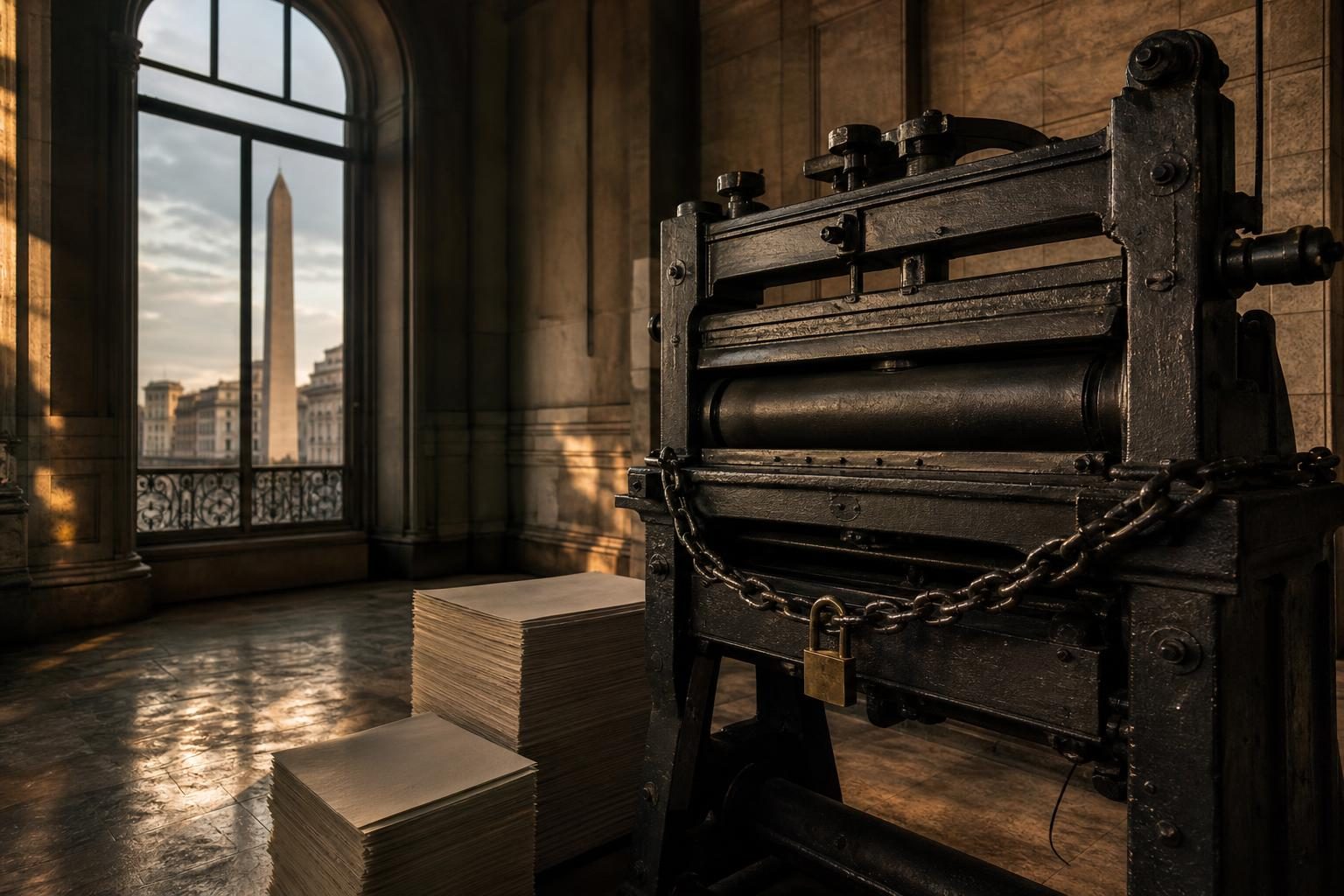
Javier Milei's new central bank charter makes protecting the peso the bank's main job. Inflation has fallen from nearly 300% to 33%, and the law is meant to keep future governments from undoing that.
Filed November 27, 2026 · 📍 Washington, DC 20001
Were you there? Share your story
Key points
- Argentina's Congress gave final approval Thursday to a law barring the central bank from financing the government.
- The new charter makes preserving the peso's value the bank's main mission and drops Kirchner-era employment goals.
- The Senate removed Milei's two-thirds safeguard for removing the bank's leaders.
- Annual inflation has fallen from nearly 300% in early 2024 to 33%, though the economy appears to be in recession.
Argentina has done something its politicians resisted for generations: it has taken the printing press away from the government. Congress gave final approval on Thursday to a law that bars the country's central bank from printing money to pay the government's bills, the Associated Press reported [1]. The measure is a centerpiece of President Javier Milei's campaign to break Argentina's long habit of inflation, and it passed less than a year before he faces voters again [1].
What the Law Does
Under the new charter, preserving the value of the peso becomes the central bank's "primary and fundamental mission," according to the AP [1]. The bank may no longer lend to the national government, the provinces or municipalities, and it is barred from financing the Treasury by other routes, the AP and The Epoch Times reported [1][2]. Reports on the final text say it also ends the temporary cash advances the Treasury has long drawn from the bank and forbids the bank from buying government debt directly [2][3].
The law strips out the employment and economic-development goals that were added to the bank's mission under former President Cristina Fernández de Kirchner [1][2]. Those goals sounded generous. In practice, a broad mandate gave governments a ready excuse to have the bank create pesos whenever spending outran revenue.
The lower house approved the measure 141-0, with 99 deputies abstaining, according to one account of the vote [4]. A tally with no recorded votes against tells its own story: few lawmakers wanted to be seen voting to keep the money spigot open, even if many preferred not to vote for closing it.
Not Everything Milei Wanted
The final version is weaker than the president's original bill in one important way. Milei wanted a two-thirds vote in both chambers to remove the bank's leadership, a safeguard against a future government firing officials who refuse to print. The Senate dropped that clause, and the lower house lacked the votes to restore it, so a president can now replace the bank's leaders with a simple Senate majority, the AP reported [1][5]. The current governor is Santiago Bausili, a Milei appointee [1].
Critics also point out that the charter leaves currency controls in the central bank's hands and sets no clear rule for how the bank should respond when inflation rises [1][3]. Those are fair concerns. A ban on financing the Treasury is a wall around the vault, not a complete monetary framework, and a future Congress could still try to tear the wall down.
The Results So Far
The numbers explain why Argentines were willing to try something different. Milei has cut public spending sharply over the past three years, turning chronic deficits into a surplus, and annual inflation has fallen from nearly 300% in early 2024 to 33% last month, according to the AP [1][5]. That is still painfully high by American standards. For families who watched prices double and double again, it is a dramatic change.
The progress has not been painless. The vote came as Argentina's economy appears to have slipped into recession, the AP reported [1]. Spending cuts cost jobs and contracts in the short run, and Milei's opponents will press that point hard as next year's election approaches. Whether voters reward him will depend on whether lower inflation finally turns into rising paychecks.
Why It Matters Here
Americans should pay attention. Argentina has long been one of the clearest modern examples of what happens when a government treats its central bank like an ATM. Savings melt away. The poor are hit hardest, because they cannot move their money abroad or into hard assets. Trust in institutions collapses along with the currency. Inflation is a tax no one ever votes for.
The United States is not Argentina. But with federal debt high and arguments over the direction of monetary policy never far from the headlines, the principle Argentina just wrote into law is worth remembering: a currency holds its value only when politicians cannot print their way out of hard choices. Scripture condemns dishonest weights and measures, and a currency that loses a third of its value in a single year cheats every worker who is paid in it.
Argentina's lawmakers have now put that lesson into statute. The test is whether the next government keeps it.
Sources
- [1]ABC News (Associated Press)Argentina bans its central bank from printing money for the governmentOpens in a new tab ↗
- [2]The Epoch TimesArgentina's Congress Bans Central Bank From Printing Money to Finance Government SpendingOpens in a new tab ↗
- [3]Opens in a new tab ↗
- [4]Opens in a new tab ↗
- [5]La Nacion (Associated Press)Argentina bans its central bank from printing money for the governmentOpens in a new tab ↗
Should towns welcome AI data centers?
- Yes, they bring jobs and tax money
- Only if they pay their own power costs
- No, they strain water and the grid
More in Business & Economy
United Fidelity Bank Fails in Indiana; First Citizens Takes Over Its Branches and Deposits
Overnight on Main Street Money with Marcus Hale
AI Gear Drives Record Imports as the Goods Trade Gap Hits $149.5 Billion
Last night on Main Street Money with Marcus Hale
Canada First, Not the Whole Toolbox: Where Republicans Draw the Line as Democrats Take Aim at Trump's Tariffs
Yesterday on Main Street Money with Marcus Hale
Were you there?
If you were at the scene, or this story touched your life, tell us what you saw and what it was like.
Discussion 0
Sign in or create a free account to join the discussion.
No comments yet. Start the discussion.